Colombia: Historic Progress, Historic Challenges

By Fulton Armstrong

Colombia Peace

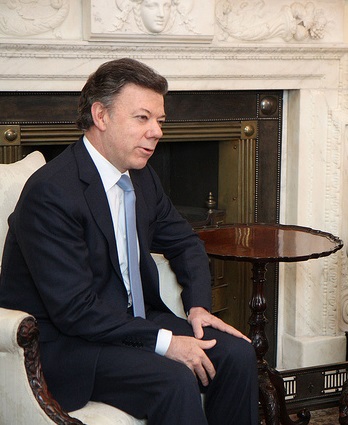
The leadership shown by Colombian President Santos and FARC Commander “Timochenko” – encouraged by the Vatican and the governments of Cuba, Norway, and the United States – will be tested as challenges to completion and implementation of a final accord are certain to be intense.  The President and FARC leader announced last week that they’d resolved the thorny issue of justice for guerrilla and government commanders accused of serious crimes and set a deadline of 23 March 2016 to sign a peace agreement.  The most important – and controversial – provision covers “transitional justice” for a range of offenses, including crimes against humanity.  Most of the estimated 6,000 rank-and-file FARC combatants will get amnesty, while commanders will choose between confessing their crimes and serving five- to eight-year terms performing labor in institutions other than prisons, or refusing to cooperate at the risk of much longer terms in prison.  (The same procedures will be established for government military officers accused of atrocities and those guilty of financing the paramilitary fighters who ravaged the countryside through the mid-2000s.)  The FARC also agreed that guerrillas would begin handing in their weapons when the final accord is signed.  Negotiators had previously agreed on rural development strategies, political participation, and counterdrug policies.

Almost universally, the agreement has been hailed as an historic achievement.  The announcement in Havana capped three years of talks facilitated by “guarantors” Cuba and Norway and later supported by the United States, represented by former Assistant Secretary of State Bernard Aronson.  During a mass in Cuba several days earlier, Pope Francis had implored the two sides to strike a deal, noting that “we do not have the right to allow ourselves yet another failure on this path of peace and reconciliation.”  U.S. Secretary of State Kerry called the Havana accord a “major breakthrough” and pledged that Aronson would stay closely engaged.

Latin American peace accords – most ending wars much shorter than the five decades of Colombia’s – provide ample evidence that the road ahead, however historic, will not be without difficult challenges.   

  • The accord will require a constitutional amendment, and President Santos will have to submit it for congressional approval and a national referendum. Former President Uribe, who leads Centro Democrático, has already declared war on it, calling it “a coup against democracy” that will lead to a “new dictatorship backed by guns and explosives.”  (Uribe also attacked Kerry’s statement as “deplorable.”)  Public discussion of details of guerrilla abuses, including forced youth recruitment and sexual violence, will play into opponents’ hand.
  • Colombian Prosecutor General Alejandro Ordóñez, an Uribe ally, said last week that any accord that does not entail prison terms for FARC commanders guilty of crimes would be “legally and politically untenable.” He claimed that it would violate victims’ rights and international law, which requires that punishment for war crimes be “proportional to the crimes committed.”  Human Rights Watch also condemned the provision and predicted the International Criminal Court would do so as well. 
  • Fulfilling commitments in the agreement to address the longstanding lack of government infrastructure in huge expanses of the country, help even modestly the resettlement of the more than 5 million persons displaced by violence, and expand programs to alleviate poverty and income inequality will have price tag beyond Colombia’s current ability to pay. Informal estimates of the 10-year cost are $30 billion.  The willingness of Colombian elites, who only grudgingly paid a war tax, to help foot the bill is far from certain.
  • The FARC’s ability to enforce discipline among its rank and file is also untested. There are reports that some commanders oppose any agreement.  Moreover, like demobilized paramilitary combatants, many combatants know no life other than rural combat and will be tempted to keep their weapons and join criminal networks that continue to terrorize rural communities.
  • The outstanding U.S. warrants for the extradition on drug-trafficking charges of reportedly dozens of FARC commanders may require some finessing, but Colombia’s peace commissioner, Sergio Jaramillo, suggested confidence that Washington will not demand extraditions if, as is almost certain, they would be a deal-breaker.

September 29, 2015

Colombia’s Peace Talks: Back from the Brink

By Aaron T. Bell

"Colombia somos todos/We are all Colombia" Photo Credit: Juan Carlos Pachón / Flickr / Creative Commons

“Colombia somos todos/We are all Colombia” Photo Credit: Juan Carlos Pachón / Flickr / Creative Commons

Peace negotiations are back on track in Colombia – for now – after renewed violence put years of progress at risk.  The unilateral cease-fire declared by the FARC last December survived the Colombian military’s continued prosecution of the war for several months, including the killing in March of José David Suarez, the head of the wealthy (and drug-trade-affiliated) 57th Front.  But it was proven unsustainable after a guerrilla attack in April killed eleven soldiers, and Colombian military aerial bombardment of FARC camps in May killed 40 guerrillas, including two who had participated in the peace negotiations in Havana.  The FARC formally revoked its cease-fire and resumed attacks on military and energy infrastructure targets, making June the most active month of the FARC insurgency since negotiations began two and a half years ago.  At the urging of international supporters of the peace process, however, the FARC will implement a new unilateral cease-fire this week.  President Santos stated that the Colombian military will de-escalate as well, but – responding to polls by Gallup and Datexco reflecting public skepticism that a negotiated settlement is possible – he has also pledged to review the situation in four months and decide whether to continue negotiations.  While Santos has appointed a new Defense Minister whose public statements and record as a member of the government negotiating team indicate support for the peace talks, the President has also shaken up the military high command, promoting combat-experienced hawkish officers as commanders.

A renewed sense of urgency among negotiators appears to be emerging.  Both sides have agreed to put all of the pending issues – disarmament and demobilization, compensation for victims, and transitional justice – on the table, rather than deal with them one at a time.  This comes after several positive steps during the hiatus in talks:

  • In late May, while airstrikes on guerrilla camps were resuming, units of the FARC and the Colombian military collaborated in several operations to remove land mines. Colombia is the second most deadly country for land mines, behind only Afghanistan, with over 2,000 people killed and another 11,000 maimed since 1990.  A video on the web last week provided a dramatic example of the need for such measures – a Blackhawk helicopter exploding after landing in a minefield last month.
  • On June 4 negotiators agreed on the makeup of a post-accord Truth Commission. Eleven members will have three years to identify collective (rather than individual) responsibility for abuses.  It will have no mandate to recommend or impose punishment, leaving that instead for an as yet to be agreed upon transitional justice tribunal.
  • Both the FARC and coca growers have called on the government to begin implementing the preliminary agreement on the illicit drug trade, including crop substitution and voluntary eradication. (Recent reports from the United Nations Office on Drugs and Crime and the White House Office on National Drug Control Policy, which use different raw numbers and data-gathering methodologies, show that coca production in Colombia rose significantly in 2014.)  Even though, as InsightCrime has noted, the initiative will be hindered by the lack of a bilateral cease-fire and firm plans for demobilization, it’s a positive step.

Despite the skepticism implicit in the review it will make in four months, the Santos administration appears to be inching toward the bilateral cease-fire that the FARC has long called for.  The government formerly insisted that a bilateral cease-fire would only take place after accords were signed, but has said it would consider one so long as it is “serious, bilateral, definitive and verifiable.”  On the other side of the table, the FARC shows some sign of bending on the thorny matter of transitional justice.  After adamantly opposing jail time for its leaders, FARC negotiators say they will consider some form of confinement for a reduced time period so long as military officials and civilian supporters of right-wing paramilitaries face similar standards of justice.  This may be difficult to swallow for a Colombian military whose culpability in war crimes is bubbling to the surface, such as in a recent report by Human Rights Watch on the extrajudicial killing of thousands of civilians.  The ever-present threat of military opposition to a negotiated accord, coupled with rising public skepticism, suggest the time to make concrete progress toward an accord is now.  The window will not stay open long.

July 21, 2015

Colombia’s Peace Talks: The End of the Beginning

By Aaron T. Bell

Americas Quarterly / Flickr / CC BY-NC 2.0

Americas Quarterly / Flickr / CC BY-NC 2.0

Recent events suggest that, as peace talks between the Colombian government and the FARC guerrillas resume in Cuba later this month, substantial progress toward an agreement is at hand.  Talks were suspended in November when a Colombian general and two lawyers were kidnapped under circumstances that remain unclear, but cooler heads prevailed and the three were quickly released.  The FARC announced an indefinite unilateral cease-fire in late December and, in the first such act taken by either side, acknowledged their responsibility for a 2002 civilian massacre in the town of Bojayá and asked for forgiveness from victims.  President Juan Manuel Santos has been reluctant to ease military pressure on the guerrillas, but the FARC’s show of good faith led him to call on government negotiators last week to prioritize the arrangement of a bilateral cease-fire.  Santos has encouraged negotiators to accelerate talks so that a public referendum on the peace accords can be held concurrent with October’s local elections.

A final agreement may still be several months off as negotiators work through the complexities of victim compensation and a transitional justice system, but the effects of negotiations are already being felt in Colombia.  Observers from the Centro de Recursos para el Análisis de Conflictos reported the lowest level of violence related to the armed conflict in 30 years during the first three weeks of the FARC’s cease-fire. This news was complemented by reports that Colombia’s murder rate hit a 30-year low in 2014, thanks in part to truces brokered among the country’s largest criminal gangs.  The success of the government’s negotiations with the FARC appears to be spilling over into the armed conflict with the ELN guerrillas as well.  At the beginning of 2015 the ELN announced willingness to enter into peace talks like those with the FARC, and they strongly implied that such talks would lead them to lay down their arms.  A six-point agenda for negotiations was publicly announced this past weekend, and a cease-fire may not be far behind.  In economic terms, an end to insurgent violence may spell much-needed relief for Colombia’s oil industry, a frequent target for guerrilla sabotage over the years, which is now reeling from falling oil prices.  Negotiations have also procured European political and financial support for Colombia.  Beginning this month, the European Union will begin funding a five-year, $86 million program to bolster small-scale producers and reduce rural inequality, and other potential funding may result from a European tour by Santos last fall.  Germany pledged $95 million in loans to follow peace agreements, and the EU and several member nations pledged funding for post-conflict reconstruction projects.

While the Santos government and the FARC appear to be entering the endgame of peace negotiations, the process of resolving the underlying conditions that have fueled decades of conflict in Colombia will be long and difficult.  The FARC was unhappy with the government’s unilateral decision to implement a peace referendum, preferring instead a constituent assembly that would give greater representation to traditionally marginalized groups in Colombian society.  Political inclusion is a substantial concern given both Colombia’s history and the attitude of right-wing opponents of negotiations.  Among the groups gearing up for a substantial run in the October elections is the Centro Democrático, the party of former president Álvaro Uribe, which took Santos to a second round of voting in last summer’s presidential elections.  Uribe claimed recently that the FARC – with Santos’s support – is using the threat of terrorism and the allure of peace to take power through elections in 2018 and even eventually establish a “totalitarian government.”  Land reform is another major concern.  Skewed land distribution has traditionally been a major source of social unrest and has worsened over the last 50 years of fighting.  Amnesty International and Oxfam have identified serious obstacles to resolving the problem and it will be difficult to ensure that large multinationals won’t benefit disproportionately from redistribution schemes.  The government and the guerrillas both deserve praise for their progress, but winning a lasting peace will require continued cooperation in reforming an ingrained system of inequality and exclusion.

January 20, 2015

Colombia’s Peace Talks: One Step at a Time

By Aaron T. Bell

Number 10 / Flickr / CC BY-NC 2.0

Number 10 / Flickr / CC BY-NC 2.0

The peace talks in Havana between the Colombian government and the FARC guerrillas have continued to show slow but steady progress since President Juan Manuel Santos, who has staked considerable political capital on ending the 50-year conflict, began his second term three months ago.  Two years of negotiations have produced preliminary agreements on agricultural development, political participation, and resolving the illicit drug trade.  In August, negotiators turned their attention to compensating victims of the conflict, while a sub-commission staffed by top military figures from both sides has been developing recommendations for implementing a bilateral ceasefire and disarming combatants.  A recent ruling by the Constitutional Court has paved the way for the government to hold a public referendum on the peace accords once a final agreement between the two sides has been reached.

The challenges facing the successful negotiation and implementation of peace accords are significant.  At home, former president Álvaro Uribe and his allies continue to harangue President Santos, accusing the government of showing too much leniency in negotiations and most recently denouncing the participation in Havana of the FARC commanders accused of human rights abuses as an affront to their victims. Santos clashed publicly with the Inspector General (procurador general) as well after the President secretly approved trips to Cuba by the FARC’s leader, “Timochenko.”  For its part, the FARC has expressed reservations over immediate disarmament, still haunted by the deaths of thousands of members of its mid-1980s political party.  Also at issue is the fate of those guerrilla leaders who face active arrest warrants or have been tried in absentia for humans right abuses; the FARC has adamantly resisted the possibility of jail time for its members.  The government is also concerned that 10-20 percent of the FARC members will shift loyalties to organized criminal gangs after the war ends.  Severing ties between drug trafficking and the FARC supporters will require, among other things, a serious commitment to rural development to foster social inclusion for farmers who rely on coca plants for their livelihood.

In spite of these challenges, both sides have displayed a serious commitment to negotiating an end to decades of war.  The FARC has used past ceasefires to rebuild and organize its military strength, hence the government’s delay this time in negotiating an end to hostilities.  But attacks on infrastructure and security services are down from 2013, and members of the FARC have by and large respected several self-imposed ceasefires announced by the central command, most recently during this summer’s elections.  Santos has gone out on a limb by allowing wanted criminals to travel to the negotiations, but that decision is consistent with other policies.  When war crimes victims were invited to tell their stories to negotiators, Santos brushed outside critics and ensured that victims of the FARC, state, and paramilitaries were all equally represented.  Public support for the peace process looked shaky in September but has rebounded, as new polls from Gallup released last week shows over 60 percent of Colombians favor talks.  The government public release in early October of the preliminary agreements appears to have helped, silence critics who accused the government of selling out to guerrilla demands behind closed doors.  There is still considerable work to do in reaching an agreement, selling it to the public, then putting it into practice, and public support may waver if the process drags on into next year.  But, the environment has never looked as favorable for peace in Colombia as it does today.

November 13, 2014

Latin America United Against Violence in Gaza

By Aaron T. Bell

Sergio / Flickr / Creative Commons Attribution-NonCommercial-ShareAlike 2.0 Generic (CC BY-NC-SA 2.0)

Sergio / Flickr / Creative Commons Attribution-NonCommercial-ShareAlike 2.0 Generic (CC BY-NC-SA 2.0)

Israel’s assault on Gaza this summer provoked sharp criticism from Latin American governments.  Condemnation came not only from Cuba, a long-time critic of Israel, and from Bolivia, Venezuela, and Nicaragua, which have been without diplomatic ties to Israel since cutting them after previous conflicts in Gaza in 2009 and 2010.  This summer’s UN-estimated 1,500 civilian deaths also provoked outrage from center-left governments, as Brazil, Chile, Ecuador, El Salvador, and Peru all withdrew their ambassadors.  At the Mercosur summit at the end of July, Brazil, Venezuela, Uruguay, and Argentina issued a joint statement in which they criticized Israel’s “disproportionate use of force…which has almost exclusively affected civilians.”  And one of the largest popular demonstrations worldwide against the Israeli action took place in Chile, home to hundreds of thousands of Palestinian descendants.

Latin American interest in Israeli-Palestinian affairs is deeply rooted in the past.  Waves of immigration beginning a century ago have made the region home to the largest Palestinian diaspora outside the Arab world.  Latin American governments provided crucial support for the 1947 UN Partition Plan for Palestine that led to the creation of the state of Israel, but they roundly condemned the occupation of the Gaza Strip 20 years later.  In the Cold War era, Israel provided military hardware to rightwing military regimes in the region while the Palestine Liberation Organization, more leftist than Islamic in its revolutionary views, lent political and economic support to the Sandinista government in Nicaragua.  Contemporary Latin American governments have taken a balanced approach in their relations with Israel and the Palestinians.  All but Colombia, Mexico, and Panama have recognized a Palestinian state based on national borders prior to the 1967 Arab-Israeli war, and trade with Israel has flourished.  Brazil is the top destination for Israeli exports, totaling over $1 billion per year.  In addition, Israel signed free trade agreements with Mercosur in 2007 and 2010; became an official observer to the Pacific Alliance (Chile, Colombia, Mexico, and Peru) in 2013; and in May 2014 approved a four-year, $14 million plan to boost trade with the PA nations and Costa Rica.  Israel’s recent efforts to further trade in Latin America ironically developed out of a desire to shrug off some of its dependency on Europe, where criticism of Israeli policy has become widespread and boycotts of Israeli goods are being organized by advocates of the Palestinian cause.

This summer’s fighting in Gaza chilled diplomatic relations between Latin American governments and Israel.  The Israeli Foreign Ministry described the withdrawal of Latin America ambassadors as a “hasty” decision that would only encourage Hamas radicalism, and it struck a nerve in Brazil when dismissing its “moral relativism” as an example of “why Brazil, an economic and cultural giant, remains a diplomatic dwarf.”  But both Israel and Latin America stand to gain from stronger economic ties, and with the exception of Chile’s suspension of trade talks, there are no pending signs that economic relations will suffer further now that this round of fighting in Gaza has come to an end.  The significance of this summer’s events lies instead in the autonomous decision by Latin American governments of all political stripes to act in favor of peaceful conflict resolution and the protection of civilians enveloped by the violence of war.  The Assad regime’s massacre of its own citizens in Syria in recent years provoked a more reticent condemnation from Latin America’s center-left governments and regional blocs, which backed a negotiated solution to the conflict while strongly opposing the possibility of foreign military intervention.  Without the specter of a wider conflict looming over this summer’s Gaza crisis, Latin American governments seized the opportunity to stake out a firmer position.  The region’s reaction to future atrocities – which may come sooner rather than later as the US prepares to battle the “Islamic State” in Syria and Iraq – will show how durable this new approach will be.

Colombia: Four More Years for Santos

By Eric Hershberg

Photo Credit: eltiempo.com / Foter / Creative Commons Attribution-NonCommercial-ShareAlike 2.0 Generic (CC BY-NC-SA 2.0)

Photo Credit: eltiempo.com / Foter / Creative Commons Attribution-NonCommercial-ShareAlike 2.0 Generic (CC BY-NC-SA 2.0)

Incumbent center-right president Juan Manuel Santos emerged triumphant from yesterday’s second round of presidential balloting in Colombia – giving momentum to his peace talks with the FARC and his efforts to continue improving the country’s democracy.  He defeated challenger Oscar Iván Zuluaga, of the rightwing Union of the Democratic Center, which is led by former President Álvaro Uribe, a polarizing figure remembered in Washington as George W. Bush’s favorite Latin American leader.  Santos prevailed by a clear margin of five percentage points, and Colombia’s technically impeccable vote-counting process virtually ensures that the outcome will not be disputed.  The turnout of 2.4 million additional voters yesterday reduced voter abstention from 60 percent in the first round to a still-worrisome 52 percent.  Regional divisions among the electorate were striking: in some areas long plagued by Colombia’s civil conflict, the President won overwhelmingly, and he achieved substantial gains in Bogota, winning a strong majority, thanks in large measure to the endorsement of leading leftist politicians.  By contrast, in the central and southern parts of the country, particularly in Antioquia, the bastion of Uribismo, the opposition candidate garnered nearly two thirds of the vote.

The candidates’ campaigns focused on the polarizing issue of peace talks with the Revolutionary Armed Forces of Colombia (FARC), which Santos launched early in his administration and have proceeded slowly but steadily in Havana.  The President sought a second term in order to complete the negotiations and end a conflict that some estimate has taken more than 200,000 lives and caused devastating human and material damage over the past half century.  By contrast, Zuluaga, taking his cue from his mentor and chief advocate Uribe – who had spent Santos’ first term and virtually all of the campaign vilifying the President as a traitor for having launched the talks – changed approach in the second round and suggested that he, too, sought peace but would impose far more stringent preconditions before talks.  Most commentators viewed his shift as suggesting a return to the Uribe-era policy of crushing the insurgency before speaking with it.  Ironically, polls showed an electorate that was barely interested in the talks and far more concerned with other issues as elsewhere in Latin America: citizen security, unemployment and public services (such as health, education and transportation) were at the forefront of voters’ concerns.  On these fronts the two candidates offered little to distinguish themselves from one another.  Further assessments of the voting data will indicate whether this may account for low voter participation in an election that outsiders perceived as momentous.

While commentary in Washington and abroad has focused on the implications of the election for the peace process, the longer term consequences may lie elsewhere, particularly in the robustness of Colombia’s democratic institutions.  We will never know the extent to which Zuluaga would have been a pawn of Uribe, but suspicions were widespread that he was to the former President as Dmitry Medvedev was to Vladimir Putin.  Thus, beyond potential reversal of the negotiations for peace, a Zuluaga presidency might have entailed a return to authoritarian practices that had undermined Colombia’s democracy under Uribe and that Santos did much to rectify.  Although he is a staunchly establishment figure, Santos has advanced the spirit and letter of the 1991 Constitution, a progressive charter that emphasized separation of powers, rule of law, a strong and accountable judiciary, as well as minority representation and unwavering respect for human rights and accountability for abuses.  Santos also embodied a spirit of reasoned deliberation both at home and in matters abroad.  His pragmatic dealings with the often troublesome regime in neighboring Venezuela have been a far cry from the saber rattling that the rightwing authoritarian populist Uribe directed toward his similarly bombastic leftwing authoritarian counterpart Hugo Chávez.  Four more years of Santos may or may not produce tangible advances on the issues that seem to preoccupy the Colombian electorate – jobs, public safety and services – but they probably will ensure continued strengthening of democratic institutions and continued opportunities for Colombia to join with sensible governments elsewhere in the region to cooperate productively regarding Venezuela and other regional concerns. It may also pave the way towards a lasting peace and some degree of reconciliation for a country long plagued by civil war. 

Colombian President Santos’s Challenges Now … and Later

By Fulton Armstrong
Embed from Getty Images
Colombian polls continue to give President Santos a comfortable margin in a second-round re-election victory, but the gap is closing – and an array of issues plaguing his campaign suggest serious challenges ahead for a second term.  The economy grew 4.3 percent last year, and optimism about future growth is so strong that the central bank is implementing measures to keep inflation under control.  The peace process with the FARC has been tedious – yielding agreements on only two of five main agenda items over 17 months of talks – but the fundamental drivers of the talks, including fatigue on both sides, remain strong.  But a number of political messes are swirling around the President:

  • The Army was caught red-handed spying on Santos’s top advisors in the FARC negotiations, suggesting disloyalty to him as Commander in Chief.  (The intercept center that police last week [6 May] raided was not the Army’s.  It was staffed by contractors reporting to the Centro Democrático, the party of former President Uribe and Santo’s leading rival in the election, Óscar Iván Zuluaga.)
  • Uribe, who in March won a seat in the Colombian Senate, has been a relentless critic and drawn Santos into public spats.  Santos recently called on the former President to “stop causing the country harm” and to stop politicizing the Armed Forces.
  • An agricultural strike launched in late April has revived memories of a nasty confrontation last year and threatens food supplies in the run-up to the election.  Santos has mobilized police and military assets to keep highways open, but a political solution has eluded him.
  • In late April, the courts forced Santos to reinstate Bogotá mayor Gustavo Petro, whom he had removed a month earlier because the nation’s inspector general, an Uribe partisan, found that the mayor’s decision to cancel private garbage-collection contracts did not follow proper procedure.  Santos had gone ahead with the firing over the objections of a unanimous Inter-American Human Rights Commission.
  • Santos’s political message has been off target.  He has made the peace talks his top priority and proclaimed that “the second term will be about peace,” but polls indicate that only 5 percent of voters say the peace process is their top concern.

If the polls are correct, Colombians voting in the first round on May 25 and second round on June 15 feel little enthusiasm for Santos, but even less for Zuluaga and Uribe’s party.  A recent surge in support for former Bogota mayor Enrique Peñalosa suggests, on the other hand, that voters could turn on both candidates.  Behind the numbers is a country eager to consolidate its democracy, maintain stability and – probably – end the 50-year insurgency.  But the red flags – such as the security service’s continued penchant for spying on government officials – are not inconsequential.  Santos, who was Defense Minister during Uribe’s presidency, should have earned the military’s confidence, will have to decide how far to push the military to respect democratically elected civilian leadership.  The farmers’ demands, including relief from low-priced, low-quality imports facilitated by Colombia’s free trade agreements, will also be difficult to satisfy.  A peace deal with the FARC will be an historic achievement, but the political reality is probably that any assistance to demobilized combatants will be minuscule compared to that given to the former paramilitaries – increasing the likelihood that ex-insurgents, like the paramilitaries, will join the bandas criminales (BACRIM) who continue to maraud throughout large swaths of the country.  Santos’s second term, should he win one, will not be easy.

Colombia: President Santos’s Challenges

By Maribel Vasquez

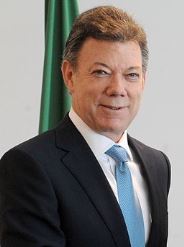
President Santos Calderón / Photo credit: Agência Brasil, Creative Commons

President Santos Calderón / Photo credit: Agência Brasil, Creative Commons License

Colombian President Juan Manuel Santos has yet to announce whether he will seek a second four-year term in May, but with the November deadline fast approaching for him to declare his candidacy, many Colombians are expressing dissatisfaction with his performance. Three years after taking office, and after a protracted honeymoon period, Santos’s approval ratings dropped to a dismal 21 percent several weeks ago. (A more recent poll surged to 41 percent but the rollercoaster ride appears likely to continue.) Colombia has experienced a wave of strikes and protests – perhaps reflecting a phenomenon evident from Brazil to Chile to Peru by which popular sentiment nosedives despite steady economic growth because much of the population is left out and institutions fail to respond to needs. The Santos administration has governed more democratically than his predecessor and shown greater commitment to the rule of law and accountability. Unlike the Clintonian dictum that “It’s the economy, stupid,” Colombia’s long-standing adage has been that “La economía va bien, el país va mal.”

The stalled peace talks between the Colombian government and the Revolutionary Armed Forces of Colombia (FARC) are also to blame for Santos’s dwindling public support. On October 13th, the 15th round of negotiations concluded in Havana without visible progress towards an agreement. (Talks are set to resume next week.) The agenda has six major points agreed to by both sides: land reform, political participation, disarmament, illicit drugs, rights of the victims, and implementation of an eventual peace accord. To date, agreement has been reached on only land reform and rural development. A number of thorny issues persist, including the FARC’s demand that a constituent assembly be convened to incorporate the peace deals into the country’s constitution – which the government has rejected.  In the latest development, the government also turned down the FARC’s call to have civil rights activist Reverend Jesse Jackson act as mediator in the release of Kevin Scott Sutay, a former U.S. marine abducted by the FARC earlier this year. Criticism of Santos’s handling of the talks is due in part to perennial public concern that the FARC is stalling the peace talks to regroup and rebuild its capabilities.

President Santos has staked his political legacy on ending Latin America’s longest-running armed conflict. Success or failure of the peace talks will define his presidency for many Colombians, and failure to reach an accord would cast a cloud over his political future. While he has talked tough – saying FARC stalling is wearing out the government and the Colombian people’s patience – President Santos appears in every bit of a hurry to see these negotiations come to a conclusion before the end of the year. Former President Alvaro Uribe and his loyalists in the Centro Democrático (CD) have already blasted what they claim is excessive leniency on the President’s part.  Santos is in a bind: if he rushes the peace talks, he risks making too many concessions and playing into the Uribistas’ hand, while canceling the talks would strip him of the desired distinction of being Colombia’s peace president. The easy road to reelection – effective conclusion of the peace process and greater responsiveness to the country’s widespread malaise – seems remote.  A strong opposition candidate has yet to emerge, however, giving Santos time to rebuild public support. CD frontrunner Francisco Santos’s recent threat to leave the party hints at a split within Uribismo.  The failure of an organized opposition may be the only advantage Santos has at the moment.

Colombia’s Uribe Out of Office, But Not Out of Mind

By Tom Long

Alvaro Uribe receiving the Medal of Freedom | Photo credit: White House photo by Chris Greenberg / Foter.com / Public domain

Alvaro Uribe receiving the Medal of Freedom | Photo credit: White House photo by Chris Greenberg / Foter.com / Public domain

Former Presidents George W. Bush and Álvaro Uribe of Colombia were close allies in the “war on terror,” but they are taking very different approaches to their post-presidency.  While the former has taken up painting and appears at few public events, since leaving office in 2010 Uribe has consistently tried to upstage his hand-picked successor, Juan Manuel Santos.  He has frequently taken to Twitter with biting criticisms, and in recent months – as provincial and municipal elections near – Uribe’s public condemnations have grown both more vociferous and more damaging.  Even ardent supporters of Uribe’s presidency are questioning his post-presidential politicking, according to press reports.

In particular, the former president’s attacks on the ongoing peace talks with the FARC and Colombia’s more conciliatory approach to Venezuela have contributed to a drop in Santos’ support, according to polls, and made the two endeavors more difficult and politically costly.  On the former, Uribe has repeatedly accused Santos of offering “impunity” to FARC fighters.  He’s also accused Santos of “turning his back on democracy” for joining (albeit reluctantly) the UNASUR consensus to recognize Nicolás Maduro’s narrow victory in the Venezuelan presidential elections.  And Uribe has slammed Santos’s efforts to hold Uribe-era officials responsible for violence and corruption.  Though Uribe’s attacks have complicated Santos’ position with his own party on these issues, the reaction has been quite different in the United States.  Though Uribe’s criticism has found an audience with the far right in the United States, Santos retains considerable U.S. backing.  Uribe’s role as the main U.S. ally in South America in the past was warmly rewarded and he was held up as Colombia’s savior – President Bush gave him the Medal of Freedom – but his hectoring of Santos and his failure to atone for violations during his government appear to have undermined his credibility.

Uribe’s post-presidential antics should spark a re-evaluation of his presidency, even among those who downplayed human rights problems and suspected links to paramilitaries among Uribe’s party and family.  His accomplishments in rebuilding the Colombian military and imposing tactical defeats on the FARC cannot be denied, but in doing so, he ran roughshod over civilian institutions, used a secret intelligence unit to harass opponents in and out of government, and, with the deaths of potentially thousands of “false positives,” appears to have been complicit in serious violations of human rights. Out of office, he continues to show a similar lack of respect for democratic processes and decorum – even as he levels that same accusation against Venezuelan leaders – and he still seems profoundly resentful that he failed to amend the Constitution to allow himself a third term.  In a democracy, there can only be one president at a time.  Former presidents have the right to speak out, but it’s fair to ask if their goal is constructive and contributes to the integrity of democratic institutions.


Is the Truth Finally Arriving in El Salvador?

By Héctor Silva Ávalos

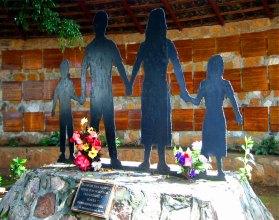
Memorial of massacre site at El Mozote, Morazan, El Salvador | By Efrojas | Wikimedia Commons | public domain

Memorial of massacre site at El Mozote, Morazan, El Salvador | By Efrojas | Wikimedia Commons | public domain

A U.S. court is on the verge of making a major contribution to El Salvador’s struggle to end impunity.  A former Salvadoran military commander six weeks ago admitted in a Miami immigration court that his troops had engaged in human rights violations and extrajudicial killings in the 1980s.  More significantly, he confirmed that the U.S.-trained and -funded Atlacatl Battalion was responsible for the horrendous massacre at El Mozote, a hamlet in which the elite Marine-style battalion killed an estimated one thousand peasants, mostly women and children, over three days in December 1981.  Until recently, current and former military commanders claimed that reports of the bloodbath were communist propaganda.  In his defense, General José Guillermo García, who was defense minister, said he was unaware of the soldiers’ actions at the time.  The judge responded skeptically, saying García “didn’t do what a military officer respectful of the law should have done in order to fully serve his country and his people.”

The General’s confession is no small matter.  An Amnesty Law passed in 1993, pushed by allies of the war-era government, put the lid on many investigations.  Its passage kept two mid-ranking officers convicted of involvement in the 1989 Jesuit massacre from serving their prison sentences, and it paved the way for other military and civilian leaders to cover up that atrocity. The air of impunity has endured for 20 years.  General García’s testimony provides the first real open window for Salvadorans to start learning about what happened despite strong efforts to keep the truth under wraps.  The political and economic elites’ defense of the Amnesty Law has focused on the argument that El Salvador should not be confronting its past if it really wants reconciliation and peace.  But two decades after the peace accord brought the end of the war, that kind of thinking is beginning to fade, and will continue to wane as Salvadoran society is confronted with the naked truth, the naked horrors.

The Obama Administration deserves some credit for advancing the legal case against García and a former colonel facing similar immigration charges in Boston, Inocente Orlando Montano.  Both processes have been encouraged by a U.S. policy of locating and ousting foreigners on U.S. soil who have been credibly accused of human rights violations abroad.  However ironic it is that some of the violations were committed by units receiving U.S. assistance, Washington is promoting an important lesson:  generals who once held in their hands power over citizens’ lives and deaths become common defendants – criminals – when the truth is known.  The impunity enjoyed by the colonels and generals – and their civilian sponsors – has grown roots in Salvadoran institutions and still feeds today a culture of obscurity, injustice and inequity that prevents the country’s progress towards development and modernity.  This vicious cycle will not will not end until they are held accountable.

Read the full text of this essay.