Chile’s Transition to Clean Energy Matrix

By Thomas Andrew O’Keefe*

Giant wind turbines in Northern Chile

Parque Eólico Canela in Coquimbo, Chile, one of many wind-producing farms in Northern Chile. / Wikimedia / Creative Commons

Since Michelle Bachelet’s return to the presidency in March 2014, Chile has aggressively pursued an ambitious program to transition the country’s energy matrix toward non-conventional renewable resources.  The emphasis on non-conventional includes mini-hydro facilities with a generating capacity under 20 Megawatts, geothermal, solar, wind, biomass, and potentially ocean currents.  Chile aims to generate 60 percent of its electricity from domestic renewable energy resources (including all forms of hydro) by 2035, and 70 percent by 2050.  To encourage that transition, Chile is one of only two Latin American countries (the other being Mexico) to establish a carbon tax, under which energy-intensive industries and utilities that exceed mandated emissions levels are charged US$5.00 per ton of CO2 emissions.  Chile’s drive to adopt a cleaner energy matrix is motivated as much by a desire to reduce greenhouse gas emissions as it is to enhance energy security.

  • During the mid-1990s, Chile faced consecutive years of severe drought that had hugely detrimental impacts on the country’s dams, responsible at the time for around 50 percent of the country’s electricity. An abundance of natural gas in neighboring Argentina led to the construction of pipelines across the Andes and new thermal generators in Chile, but Argentina began cutting natural gas exports in 2004 (and eventually stopped them altogether) because disastrous policies there had caused domestic shortages.  Bolivia, in turn, rebuffed Santiago’s entreaties to purchase its gas unless Chile granted it territorial compensation for the loss of Bolivian access to the Pacific after the 19th century War of the Pacific.  Chile had to build two expensive receiving terminals to import Liquefied Natural Gas (LNG) from East Asia as well as Trinidad and Tobago.  The Chileans were also forced to use more coal and diesel, exacerbating the already precarious air quality in many Chilean cities, particularly during the winter.

In recent years, more than half of all investment in non-conventional, renewable energy in Latin America and the Caribbean has been directed to Chile, primarily to build solar and wind parks to supply the mining industry in the north of the country.  The shift to renewable energy has largely been financed by the private sector, with no subsidies other than reimbursement for small-scale photovoltaic and other nonconventional contributors to the grid at the full retail price (and no transmission charge).  Chile’s antipathy to subsidies reflects the country’s market-based economic orientation and a conscious decision to prioritize state-of-the-art renewable technology sourced from elsewhere rather than encourage the development of its own industry.  The recent investment boom in renewables was driven by the business-friendly climate, the fact that Chile is not a significant hydrocarbons producer, and the inflationary impact of the last three years of drought on the price of hydroelectricity.

Chile has several other things going for it in achieving its goals, including a good regulatory framework and resources that are in growing demand.  Chilean regulators allow generators to sell electricity in only one of three time blocks during the day — giving solar and wind power a competitive edge in public purchase agreement auctions.  This more than halved the bidding price offered by generators and made solar power competitive with natural gas and even electricity sourced from hydro.  In the near future, as the country’s energy matrix shifts to greater reliance on solar and wind power, Chile intends to utilize hydroelectricity to supply peaks in demand for electric power (usually in the evening hours) to make up for intermittencies in sunshine and wind.  (At the moment, fossil fuels provide that function.)  New developments in storage technology will also help.  Chile is one of the world’s largest producers of lithium, needed to make storage batteries.  The interconnection of Chile’s northern and central grids in 2018 should also facilitate greater use of different renewables and redirect the electric power generated from them to where it is most needed.  Chile, already a leader in Latin American alternative energy production, is poised to enhance that position.

September 11, 2017

* Thomas Andrew O’Keefe is President of Mercosur Consulting Group, Ltd.  He taught a seminar on “Energy and Climate Cooperation in the Americas: The Role of Chile” at Stanford’s Santiago campus during the summer 2017 quarter.
Who Really Benefited from the Commodities Supercycle – and Who Loses with Its End?

By Carlos Monge*

2017-05-13 AULABLOG_Carlos_Monge_graphic

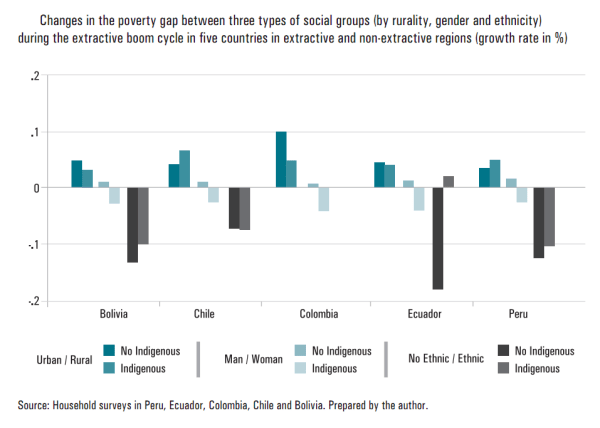
Latin American governments and business associations have tended to overstate the benefits of extractive industries during the commodities supercycle that ended in 2014-15.  Resource-rich Latin American countries did experience high rates of economic growth and diminished poverty and inequality during the boom years.  On the surface, this would appear to strengthen arguments that – despite their negative environmental impact – extractive industries are the key to progress, especially in resource-rich areas.  Nevertheless, a closer look at data from household surveys in Bolivia, Chile, Colombia, Ecuador, and Peru shows that things are a bit more complicated.

  • The inequality gap between individuals, as measured on the GINI Index, has narrowed, but the gaps between groups of the population have not evolved evenly. For example, the National Resource Governance Institute (of which I’m regional director) recently completed a study of the performance of social indicators during the supercycle that concluded that the poverty gap between urban and rural populations has increased in all countries.  (The report is available in English and Spanish.)  In Peru and Chile, the gap increased more in territories where extractive territories are located, while in Colombia, Bolivia, and Ecuador less so.  The gap between indigenous and non-indigenous populations increased only in extractive territories in Ecuador, decreasing in both extractive and non-extractive settings in the rest of the countries considered.  Regarding gender, in all five countries the gap between men and women increased slightly in non-extractive territories and decreased a bit more in extractive ones.

This report establishes correlations between the increase in extractive activities, the availability of extractive rents, and patterns of inequality reflected in social indicators, but it does not establish a causal relation between such variables.  For example, the data show that urban populations in Peru’s extractive regions have benefited more than rural ones – which some very preliminary research shows is probably because urban centers provide extractive projects with the goods and services they need, while less sophisticated rural areas do not.  At the same time, rural populations have to compete with the extractive projects for those same urban goods and services, and with local governments for the labor force that the public sector contracts to develop infrastructure projects that are paid for through increased revenues delivered by the extractive sector.  This is what we have called the “Cholo Disease.”  A variation of the “Dutch Disease,” it reflects a loss of competitiveness resulting not from large exports of raw materials causing the currency to appreciate, but rather from increases in the cost of labor and of urban goods and services consumed by campesinos.  However, a more definitive explanation regarding exactly how this happens in Peru and in other countries certainly needs further research.

While our data clearly show the impact of mining and hydrocarbons extraction and the resulting expenditure of extractive rents on the poverty gaps between urban and rural populations, men and women, and indigenous and non-indigenous populations, further investigation into the causes and consequences is needed.  The end of the supercycle has already meant a fall in growth rates and extractive revenues, leading to a worrisome rebound in poverty rates.  We are still unable to answer, however, the question of how broadly it will impact the substantial segments of Latin America’s population that emerged from poverty but remains in a vulnerable position – and how it will aggravate poverty gaps among individuals and between groups in extractive and non-extractive territories.

May 16, 2017

* Carlos Monge is Latin America Director at the Natural Resource Governance Institute in Lima.

Latin America: End of “Supercycle” Threatens Reversal of Institutional Reforms

By Carlos Monge*

Monge graphic

By Eduardo Ballón and Raúl Molina (consultores) and Claudia Viale and Carlos Monge (National Resource Governance Institute, América Latina), from Minería y marcos institucionales en la región andina. El superciclo y su legado, o las difíciles relaciones entre políticas de promoción de la inversión minero-hidrocarburífera y las reformas institucionales, Reporte de Investigación preparado por NRGI con colaboración de la GIZ, Lima, Marzo del 2017. See blog text for high-resolution graphic

Policies adopted in response to the end of the “supercycle” have slowed and, in some cases, reversed the reforms that moved the region toward greater decentralization, citizen participation, and environmental protection over the past decade.  Latin American governments of the left and right used the commodities supercycle to drive growth and poverty reduction at an unprecedented pace.  They also undertook institutional reforms aimed at improving governance at large.

  • Even before demand and prices for Latin American energy and minerals began to rise in the early 2000s, some Latin American countries launched processes of decentralization (Colombia and Bolivia); started to institutionalize mechanisms for citizens’ participation in decision making (Colombia and Bolivia); and built progressively stronger environmental management frameworks (Colombia and Ecuador). Peru pressed ahead with decentralization and participation at the start of the supercycle, and when it was in full swing, created a Ministry of the Environment.
  • Implementation of the reforms was subordinated by governments’ overarching goal of fostering investments in the extractive sector. Indigenous consultation rights in Peru, for example, were approved in the second half of 2011, but implementation was delayed a year and limited only to indigenous peoples in the Amazon Basin.  President Ollanta Humala, giving in to the mining lobby, claimed there were no indigenous peoples in the Andes and that no consultations were needed around mining projects.  Local pressure forced a reversal, and by early 2015 four consultation projects on mid-size mining projects were launched.

These reformist policies have suffered setbacks since the decrease in Asia’s and particularly China’s appetite for Latin American energy and minerals has caused prices to fall – and the value of exports, taxes, and royalties, and public incomes along with them.  The latest ECLAC data show a decline in economic growth and a rebound of poverty both in absolute and relative figures.  The gradual fall in the price of minerals starting in 2013 and the abrupt collapse in oil prices by the end of 2015 reversed this generally favorable trend.

The response of the governments of resource-dependent countries has been “race to the bottom” policies, which included steps backward in fiscal, social, and environmental policies.  Governments’ bigger concern has been to foster investments in the new and more adverse circumstances.  In this new scenario, the processes of decentralization, participation, and environmental management have been negatively impacted as local authorities and citizens’ participation – as well as environmental standards and protocols – are perceived by companies and rent-seeking public officials as obstacles to investments.

  • Peru’s Law 30230 in 2014, for example, reduced income tax rates, weakened the oversight capacity of the Ministry of the Environment, and weakened indigenous peoples’ claim public lands.

The correlation between the supercycle years and the progress and regressions in reforms is clear. (click here for high-resolution graphic).  During the supercycle – when huge amounts of money were to be made – companies and government were willing to incorporate the cost of citizen participation, decentralization and environmental standards and protocols.  But now, governments are desperate for new investments to overcome the fall in economic growth and extractive rents, and extractive companies are not willing any more to assume these additional costs.  Those who oppose the “race to the bottom strategy” are fighting hard to restore the reforms and to move ahead with decentralization, increased participation, and enhanced environmental management, to achieve a new democratic governance of the territories and the natural resources they contain.

April 7, 2017

* Carlos Monge is Latin America Director at the Natural Resource Governance Institute in Lima.

Peru: Can the Shamans Save the Glaciers?

By Karsten Paerregaard*

huaytapallanaceremony

A ceremony at Mount Huaytapallana during the Andean New Year. / Photo by Karsten Paerregaard.

Peru – one of the countries in the world most vulnerable to climate change – is experiencing a surge in religious ceremonies highlighting the plight of its rapidly shrinking glaciers, but the increased attention has downsides as well.  Peru has 70 percent of the world’s tropical glaciers, which provide most of the country’s fresh water and have been integrally linked to the identity of the Andean people since the Incas.  They are rapidly shrinking, however.  Mount Huaytapallana, a 5,500-meter-high glacier about 300 kilometers east of Lima, has shrunk 50 percent over the past quarter century – with profound implications for life throughout much of Peru.  Shamans in the region, whose ceremonies and offerings have long constituted a critical means of regulating the relationship between society and nature in the Andes, are reviving the practices to draw attention to this environmental crisis.

  • Most participants in ceremonies on Mount Huaytapallana come from Huancayo and other nearby cities in the central highlands, hoping that Huaytapallana will listen to their prayers and bring them good fortune. The Andean New Year on June 24, one of the most spectacular events, attracts more than a thousand people.  They offer food, drinks, candles, and cloths that are burned while the shamans say prayers to Huaytapallana in Quechua.  The event reminds people of the suffering that global warming is causing to the mountain.
  • In the southeastern highlands, Mount Ausungate attracts even bigger crowds. Around the feast of Corpus Christi each year thousands of pilgrims walk up to a sanctuary to pay tribute to an image called Señor de Qoyllur Rit’i (the Lord of the Snow Star), declared an Intangible Heritage Site by UNESCO in 2011.  The image represents Christ, who according the local legend revealed himself at the sanctuary in the 18th century, but it is also a religious relic of a pre-Columbian tradition of worshipping Andean mountain deities.  Dance groups from eight communities of pilgrims, known as naciones, play music and dance around the clock, and men dressed as bears climb the nearby glaciers of Ausungate to set up crosses and until recently set off fireworks.  An estimated 50,000 visited the sanctuary last year.

The glaciers are symbols of both the country’s indigenous past and the damage that global climate change is inflicting.  The growing participation in Andean ceremonies with religious overtones reflects the deepening concern for the profound social, economic, and spiritual implications of the environmental degradation.  It is fueled by a search for alternative answers to problems that global climate change is causing in Peru and that the country’s governments so far have failed to provide.  The surge in interest also, ironically, is cause for concern.  According to the regional government of Junín, responsible for the protection of Huaytapallana’s environment, visitors leave more than four tons of trash on the mountain every year.  The commercialization of the offering ceremonies makes it difficult to hold the shamans accountable for participants’ activities.  At Qoyllur Rit’i, Peru’s Ministry of Culture is in charge of preserving the pilgrimage according to Andean traditions, enhancing people’s awareness of Ausungate’s cultural importance, but pilgrims’ presence on the glaciers remains an issue of continuous dispute.  Shamans and environmentalists are a potentially powerful alliance, but even mitigating the environmental impact of activities by people concerned with climate change is not a simple matter.

February 6, 2017

* Karsten Paerregaard teaches in the School of Global Studies at the University of Gothenburg in Sweden.  He has participated in a CLALS project, funded by the Henry Luce Foundation, on Religion and Climate Change in Cross-Regional Perspective.

Haiti: Hurricane Matthew’s Devastating Impact

By Emma Fawcett*

Group of Haitians unpacking supplies

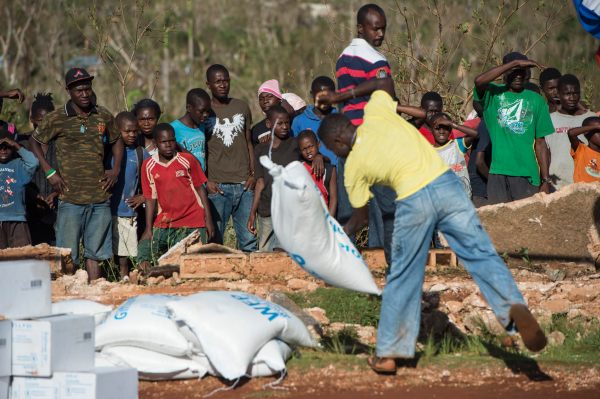
A citizen of Beaumont, Haiti unloads hurricane relief supplies from USAID on October 13, 2016. / U.S. Air Force / Photo by Tech. Sgt. Russ Scalf / Flickr / Creative Commons

Hurricane Matthew, which made landfall on Haiti’s southwestern claw on October 4, devastated citizens’ lives, homes, and businesses – and set back much more across the country.  Some 546 are reported dead, and 128 are still listed as missing.  According to World Bank estimates, the Category 4 hurricane caused nearly $2 billion in damages, including $600 million in the agricultural sector.  The hard-hit southern peninsula provides about one-third of Port-au-Prince’s food supply, and the losses of crops and fishing equipment have long-term implications for food security.  Ninety percent of the homes in the South and Grand’Anse regions were damaged or destroyed, and according to the Environment Ministry, the storm sped up deforestation and has destroyed more recently planted trees.  The relief efforts have been poorly coordinated by Haiti’s interim government, resulting in press reports of looted aid convoys and sporadic protests.

The storm has also set back almost every key initiative underway in Haiti.

  • Just two months after the United Nations finally acknowledged its role in bringing cholera to the country in 2010 (for which it subsequently proposed an aid package that includes restitution to victims), flooding and contaminated water have led to a dramatic increase in the number of cholera cases. An estimated 3,400 new cases have been reported in just the last four weeks.  With help from the World Health Organization, the Haitian Ministry of Health will begin administering 1 million doses of the oral cholera vaccine, but addressing cholera also necessitates serious improvements in access to safe water and sanitation.
  • Haiti’s elections, scheduled for October 9 and already a year overdue, were rescheduled once more due to the hurricane. They are now set for November 20, but foreign observers and candidates alike indicate that major obstacles remain.  More than 770 schools, which are typically used as polling stations, were destroyed by the storm, and roads throughout the south remain impassable.

Once again, it falls to the international community to lend Haiti a hand, but donors have been sluggish.  During a visit in mid-October, UN Secretary General Ban Ki-moon said that he was “disappointed by the response of the international community.”  Less than a third of the UN’s $120 million appeal for immediate hurricane relief has been raised – and the UN was already struggling to raise funds for its separate cholera fund.  Donor fatigue in the United States, where the government contributed several billion in tax dollars and more than half of citizens made private donations following the 2010 earthquake, has been deepened by widespread perceptions that money was wasted.  Poor coordination, wasteful spending by aid agencies, and political stagnation have meant that Haiti has little to show for the $9 billion in earthquake relief.  (The Red Cross, for example, spent $500 million on various projects, but, despite its stated focus on housing, famously built just six permanent homes.)  Canada’s anticipated assumption of leadership of MINUSTAH, the UN peacekeeping mission, from Brazil by the end of the year may help energize aid efforts.  Canada has a large Haitian diaspora population and Prime Minister Trudeau has signaled interest in taking a larger role in Haiti’s recovery, but Canada’s contributions to hurricane relief are still dwarfed by those of the United States.  Once again, Haiti lurches from one crisis to another – and it will continue to until aid and development efforts are better coordinated and the country achieves some measure of political stability.

October 31, 2016

Emma Fawcett recently completed a Ph.D. in International Relations at American University.  Her doctoral thesis focused on the political economy of tourism and development in four Caribbean countries: Haiti, Dominican Republic, Cuba, and the Mexican Caribbean.

Challenging Assumptions about Supercycles in Peru and Latin America

By Claudia Viale and Carlos Monge*

spcc_gp22eco_ilo_-_toquepala

A Southern Copper Corporation train heading towards the Peruvian mines of Toquepala and Cuajone. / David Gubler / Wikimedia Commons / Creative Commons

The commodity-fueled “supercycle” that has propelled Latin American economies for the past decade and a half is ending, but careful analysis of other ongoing cycles will help countries cushion the blow.  ECLAC economist Jean Acquatella has identified four significant global cycles in which Latin America has actively participated as a raw materials exporter through the 20th and 21st centuries: U.S. industrialization; post-war European reconstruction and Japan’s industrialization; the post-1973 OPEC-driven oil boom; and, most recently, urbanization and industrialization in Asia, especially China.  During this fourth cycle – considered a supercycle because of sustained record levels of commodity prices and demand – resource-rich countries in Latin America experienced high growth rates, fiscal abundance, and a decrease in poverty rates as well as an increase in social conflict over the extraction of natural resources.  Slower Chinese growth has since reduced global demand and prices for the region’s minerals and energy, but the impact has been less severe than at the end of previous cycles.

  • José de Echave, of CooperAcción, has emphasized the need to differentiate the recent supercycle from what he terms the “extractive boom,” which started in the early 1990s as a result of the privatization of state mining and hydrocarbons assets and pro-market legislative reforms. His analysis indicates that the extractive boom will outlast the supercycle as long as large-scale projects mature and pro-investment policies continue in place.

The concessions, investments, production and fiscal rent during the past decade and a half in Peru and other countries indeed point to other cycles, some of which have enduring momentum.  Peru has experienced a “concessions cycle” for exploration activities; “investment cycles” as a result of privatization of state assets in the ‘90s and as a result of successful explorations and increased demand and prices starting in 2002; “productive and export cycles” as a result of investments; and a “fiscal cycle” of abundant public revenue.  Several cycles will obviously decline, but the country’s pro-investment policies remain in effect.  The new government of President Pedro Pablo Kuczynski is deepening policies started under former President Humala: reducing corporate income taxes, making environment compliance less onerous, and curtailing the oversight capacities of the Ministry of the Environment.  Investments made in the last five to ten years are, in many cases, only now beginning production.  Thus, as contradictory as it might sound, Peru is poised to double its copper production in the next five years.

The complex differences between “extractive booms” and “supercycles” have deep political implications.  The end of a supercycle could mean a substantial reduction in social conflict between local populations and extractive enterprises and government, but the current “race to the bottom” driven by pro-investment policies could fuel new tensions.  The Las Bambas project in the South Andean region of Apurimac, Peru, illustrates the point.  New legal procedures adopted in 2014 easing approval of environmental impact assessments (EIA) have allowed the Ministry of Energy and Mines to approve substantial changes in the project’s design and EIA without informing the local population and authorities, generating a violent local social reaction.  Available data shows analogous phenomena underway in Bolivia, Colombia, and Ecuador.  The implications will vary for each country, of course, but careful analysis is needed if state policies and civil society activism are to be on solid ground.

October 11, 2016

Claudia Viale and Carlos Monge are Program Associate and Latin America Director at the Natural Resource Governance Institute in Lima.


Mexico: Environmental Initiatives Likely to Stir Things Up

By Daniela Stevens*

mexico-environment

Mexico City’s Reforma axis under a blanket of smog / Lars Plougmann / Flickr / Creative Commons

Mexico has made a big push on climate issues over the past month that could have far-reaching consequences internally and in the hemisphere.  On August 16, it announced a pilot Emission Trading System (ETS), also known as “cap-and-trade,” that will begin a simulation in November and officially initiate trading carbon permits in 2018.  Two weeks later, at the second Climate Summit of the Americas (CSA), the Mexican federal government signed a joint declaration with the Canadian provinces of Ontario and Québec to advance “cooperation activities on carbon markets.”  Mexico’s motives are not immediately clear.  For a middle-income nation, with annual growth (around 2 percent) compromised by the crash in oil prices, an ETS represents a potentially significant economic burden.  Mexican officials have not explained, moreover, how they might link their cap-and-trade to the Canadian provinces’ systems and to the Western Climate Initiative (WCI), North America’s largest carbon market and the second largest in the world.

The moves may be driven by increasing Mexican belief that more assertive, market-oriented approaches are necessary to meet its international commitments.

  • Mexico is dependent on fossil fuels for over a third of its total energy production, wreaking havoc with the country’s air quality. Over the last few months, Mexico City decreed several “environmental contingencies,” situations of abnormally high concentrations of ozone in the atmosphere.
  • Moreover, Mexico may be seeking the advantage that increased regional cooperation represents. Its international commitments on emission reductions are very ambitious, and a linkage to its North American partners lends itself almost as a natural solution to help in the advancement of its pledges.  Mexico could export sectoral offsets that American and Canadian partners need – contributing to Mexican revenues and to market stability.  Mexico would also benefit from the resulting transfer of information expertise, technology, training, and methodologies.
  • An important first step for the Mexican authorities would be to commit the resources to establish the robust institutional mechanisms and capacities to launch, monitor, enforce and sustain a system as intricate as a national ETS, and only after that, lend itself as a reliable partner in an internationally linked market.

The details of the pilot ETS have not been publicized, and the agreement with Québec and Ontario does not establish commitments beyond “identifying opportunities for linking systems as much as possible.”  Mexican companies already voluntarily buy and sell carbon bonds on a small national market – a system complemented by a carbon tax in place since 2013 – but an enforced and internationally linked market would highlight the disparities among the North American nations – and represent a challenge to Mexico.  Unlike its partners, Mexico is still an industrializing nation, with a thriving motor vehicle industry, and industrializing nations have traditionally been reluctant to pricing emissions.  Industrialized countries are the highest historical emitters and reached that status of development by polluting without paying the price.  Although the need to prioritize economic growth does not exempt Mexico from fulfilling its commitments as the eleventh highest global emitter, it does signal that besides opportunities, Mexico faces challenges with trading partners at different stages of development.  The Climate Summit of the Americas showed, however, that regional fora and of subnational partnerships can further environmental commitments beyond the global and national summits.  The CSA signaled an opportunity for the region to develop North American or, more ambitiously, hemispheric solutions to climate change.

September 15, 2016

* Daniela Stevens is a PhD candidate in the American University School of Public Affairs.  Her research focuses on national and subnational policies that put a price on carbon emissions.

Peru’s Frente Amplio: The Emergence of a Post-Extractivist Left

By Carlos Monge*

OperacionesYanacocha

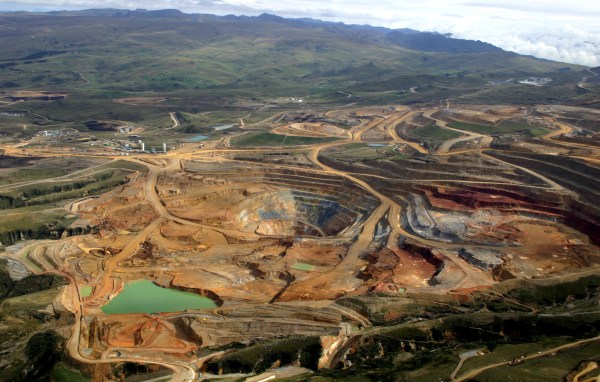
An abandoned gold mining project in the Cajamarca region, Peru / Wikimedia / Creative Commons

The surprising emergence of the Frente Amplio (FA), a coalition of political parties, social organizations and independent activists, in Peru’s recent presidential and congressional elections signals the first significant support for the Peruvian Left since the collapse of the Izquierda Unida in the 1980s.  The Left was not able to present its own alternatives in the ‘90s, the early 2000s, and again in 2011.  In October 2015 barely 13 percent of Peruvians knew about FA’s internal election to select presidential candidates.  Veronika Mendoza had the support of only 1 percent of intending voters, and over 60 percent of Peruvians did not even know who she was.  Nevertheless, FA ended up receiving 18.74 percent of the vote in the first electoral round, coming in third and only a couple of points behind Pedro Pablo Kuczynski (PPK), who secured 21.05 percent and ended up defeating the Fuerza Popular’s candidate, Keiko Fujimori, to become President for the 2016-2021 period.

FA’s “post-extractivist” program has been key.  Breaking away from the nationalist redistributive programs of leftists in Venezuela, Ecuador, Bolivia, Brazil, and Argentina, FA espouses economic diversification and tax reform rather than more mineral or hydrocarbon exports to sustain economic growth and public incomes.  FA also emphasizes the need to protect the environment and renewable natural resources for future generations and to recognize indigenous rights to territories, autonomy, direct political representation and effective consultations.

  • These are not only electoral campaign ideas. Indeed, FA local activists and national leaders have maintained staunch opposition to emblematic mining projects such as the Conga project in the northern Cajamarca region and the Tía María project in southern Arequipa.  In the same way, FA is denouncing that the new government is trying to lower air quality environmental standards to ease foreign investments in mineral smelters and has harshly criticized the new Minister of Production for abandoning the National Plan for Productive Diversification launched by the outgoing Ollanta Humala administration.
  • Frente Amplio is grounded in social movements that have long confronted extractivist projects. Veronika Mendoza left President Humala’s Nationalist Party in 2012 in a dispute over his repressive response to socio-environmental protests around mining projects in the highlands of her native Cusco.  Tierra y Libertad, FA’s largest party, has its roots in the Cajamarca rondas campesinas resistance against the Conga project.  Another factor is that the end of the commodities “super cycle” has moved extractive rents off center stage.  Even in Venezuela the official discourse is now moving in the direction of economic diversification.

Frente Amplio is not alone in Latin America in attempting to build a post–extractivist platform, but it seems to be the region’s most successful.  Similar policies were at the heart of the presidential campaign of Alberto Acosta and a coalition of social and indigenous organizations in Ecuador.  And in El Salvador, the Farabundo Martí government is also keeping extractivist temptations at bay.  But Acosta did not manage to get significant support or to build a stable political alternative, and El Salvador is not a major commodity exporter.  The importance of the FA experience is that it happens in a significant mineral and gas producer, that it has had immediate electoral success, and that it can become a permanent political player in Peruvian democracy.  FA and PPK will probably agree on issues such as the fight against corruption, crime, and violence against women, but they will certainly disagree over macroeconomic and sector policies, such as taxes.  Also, FA has denounced PPK for his call to lower air pollution standards and for his authorization to large fishing factories to operate up to 5 km off the coast, leaving very little for artisanal, small scale, internal market-oriented fishing activities.  Where this ends up is anybody’s guess, but this is certainly a process worth keeping an eye on.

August 29, 2016

*Carlos Monge is Latin America regional director at the Natural Resource Governance Institute in Lima.

Latin America (Overall) Embraces Paris Climate Accord

By Fulton Armstrong

cop21 paris accord 2015

Heads of delegations at the 2015 United Nations Climate Change Conference in Paris. Photo Credit: Presidencia de la República Mexicana / Flickr / Creative Commons

Latin American support for the landmark climate agreement signed at the United Nations last week may not have been enthusiastic during the negotiations, but all but Nicaragua seem eager for early ratification and implementation of measures to mitigate the harm of global warming.  A record-breaking 175 countries signed the accord in one day, including a number from Latin America, committing them to take concrete steps to keep the increase in global temperatures from rising 2 degrees Celsius (or, ideally, 1.5 degrees) over preindustrial levels.  To take effect, at least 55 countries producing 55 percent of global emissions must ratify the agreement.  Fifteen small island nations, including several in the Caribbean, already presented their ratification papers last Friday.  China and the United States, the two greatest emitters of greenhouse gasses, have said they’ll ratify this year – as have France and other EU countries.

The region’s leaders have made significant contributions to the accord over the years.  Mexico and Peru, which were hosts of crucial international conclaves leading up to it, have given it a Latin American imprint, and others supported the final round of talks in Paris last December.  Brazilian President Dilma Rousseff’s reference in her speech to her political troubles back home overshadowed Brazil’s leadership, including its commitment to reduce its greenhouse gas emissions by 43 percent of 2005 levels by 2030.  In the past, ALBA countries complained loudly that the wealthy, developed nations, which produce the vast majority of climate-harming gasses, should shoulder the burden of reducing them and should compensate poorer countries for harm that environmental measures cause them.  All but Nicaragua, however, have submitted national plans (called an Intended Nationally Determined Contribution, INDC) required for full participation in international efforts under the Paris Accord.  Nicaraguan Representative Paul Oquist told the media that “voluntary responsibilities is a path to failure” and that wealthy countries should compensate Nicaragua for the $2 billion cost the measures would entail.

Latin America has clear incentives to support the accord.  Various scientific studies underscore the impact of global warming on the region, with potentially dire consequences.  The World Bank and Intergovernmental Panel on Climate Change have reported that failure to act would cause further extreme weather threatening agriculture; rapid melting of Andean glaciers that provide much-needed fresh water; erosion of coastal areas; catastrophic damage to Caribbean coral reefs; and dieback of Amazon forests.  ALBA demands for compensation may be overstated but contain a grain of truth – they aren’t prodigious producers of greenhouse gasses – and skepticism that the big guys will meet their targets isn’t entirely unwarranted.  President Obama has repeatedly demonstrated his personal commitment to addressing the problem, but obstacles posed by the U.S. Senate (which must ratify the agreement), Supreme Court (which in February stalled implementation of his Clean Power Plan), and politicians seeking the Republican Presidential nomination (who have sworn opposition to deals like the Paris Accord) have all but shut down U.S. movement toward ratification.  The ALBA outliers, on the other hand, have made their complaints heard and appear likely to join the rest of Latin America and the Caribbean in pushing for ratification and quick implementation – and probably will soon renew the push for even tougher measures by industrialized nations.

April 25, 2016

Nicaragua: Where’s the Canal?

By Fulton Armstrong

Canal Nicaragua

Coming soon to Nicaragua? Photo Credit: tryangulation / Flickr / Creative Commons

The Nicaraguan government and Chinese investment group leading the Nicaragua Grand Canal project continue to claim enthusiasm for their dream, but enough fundamental problems remain unresolved to suggest that prospects for its eventual construction are dimming – and the principals are maneuvering to avoid picking up the tab for the expenditures made so far.  In a year-end statement last December, President Ortega’s office said the canal project would be one of his government’s top 25 priorities this year and emphasized its benefits to the Nicaraguan people.  Hong Kong-based HKND Group had announced in November that it was “fine-tuning” the canal design to address problems raised in an environmental impact study, which would delay the beginning of major excavations and lock-building until the end of 2016.  Company officials have since said, however, that construction of a fuel terminal and wharf on the Pacific coast –necessary to bring in the massive equipment the project requires – could start as early as this August.  The company still claims that it will complete the canal in 2020 – a prediction that few, if any, outside experts see as feasible.

The project faces massive obstacles, with no solutions in sight.

  • The estimated US$50 billion in financing is nowhere to be seen. Chinese investor Wang Jing, who has already spent US$500 million of his own money on the project, lost some 85 percent of his US$10 billion personal fortune in last year’s Chinese stock market correction.  (Bloomberg named him the worst performing billionaire of 2015.)  Observers believe his losses as well as the problematic environmental impact study have cooled his and other private investors’ support.  An initial public offering of shares has been postponed indefinitely.
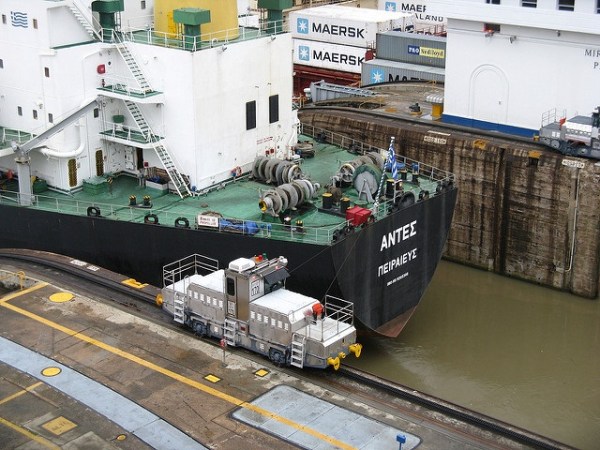
  • Project managers have yet to demonstrate the need for the canal and propose solutions to significant engineering challenges, such the need for construction able to withstand earthquakes made likely because of seismic faults along the route. HKND says the canal will handle 3,500 cargo ships a year, including ones bigger than those transiting the Panama Canal, but industry experts say there’s no demand for more than will be accommodated by the expansion of the existing canal – and that the United States has no ports capable of receiving the larger vessels.  Global warming, moreover, could soon open a faster and cheaper route north of Canada.
  • Public protests have diminished during the hiatus in canal-related news and activities, but opponents remain strident and are gaining international support. Detractors’ resolve to fight has been strengthened by the environmental report, by a credible UK firm, determining that the project will “have significant environmental and social impacts,” including dislocation of at least 30,000 Nicaraguans.  Indigenous and Afro-Nicaraguan groups on the Atlantic Coast are upset about disruptions to traditional territories, including cemeteries and holy places.  Amnesty International has condemned the treatment of affected persons as “outrageous” and “reckless.”

The “biggest earth-moving project in history” is still looking like one of the biggest boondoggles in history – yet another in a long series of chimera canals in Nicaragua since early last century.  The government says that popular support for the project remains about 81 percent, but a survey by Cid Gallup, published in the Nicaraguan newspaper Confidencial in January, showed that 34 percent of 1,000-plus respondents consider the canal to be “pure propaganda.”  One quarter believe technical studies have been inadequate and that funding will not materialize.  Those sentiments could be reversed somewhat by the appearance of massive excavation equipment and creation of related construction jobs, but support will still be tempered by concerns about persons whose lives are disrupted by the project – and by perennial and profound suspicions that corruption will take the lion’s share of benefits.  Some opposition leaders believe HKND’s big push to appear optimistic is to build a case for collapse of the project to be Nicaragua’s fault, so that the company can demand that Managua repay the $500 million that Wang has reportedly spent.  The lack of transparency surrounding the project only fuels such speculation. 

April 4, 2016