Gender Violence in Argentina and the Education of Mauricio Macri

By Brenda Werth*

Macri Ni Una Menos

Photo Credit: Mauricio Macri Facebook page. Public Domain.

Argentina’s new President, Mauricio Macri, has an historic opportunity to address the country’s longstanding crisis of gender violence.  In a radio interview in 2014, he notoriously stated that “All women like to be catcalled,” and asserted, “I don’t believe the ones who say they don’t.”  Little did he know at the time that the most intense period of his presidential campaign in 2015 would coincide with a revolution in public awareness of gender violence in Argentina.  #NiUnaMenos – a movement launched in response to a rash of femicides and their graphic coverage by the news media – organized  marches in cities across Argentina, Uruguay, and Chile, drawing an estimated 300,000 protesters in Buenos Aires alone last June.  Journalists, artists, and activists, in collective denunciation of machismo and violence against women, demanded that the government develop a plan of action to implement the Comprehensive Law on the Prevention, Punishment and Elimination of Violence against Women (Law 26.485), approved in 2009.  The law was a significant milestone in addressing violence against women at the national level, yet without government support, its effectiveness has been limited.  Current data indicate that a femicide takes place every 30 hours in Argentina, and statistics suggest that the total number of femicides occurring in 2015 will meet or surpass numbers in 2014.  The NiUnaMenos movement has captured the public’s attention.

The presidential candidates (Macri included) took note of the impact of NiUnaMenos and pledged support to prevent violence against women as outlined in the five major points it published.  Macri posted a picture of himself holding a handmade #NiUnaMenos sign on Facebook and Twitter.  Yet activists remain concerned about Macri’s sincerity, not just because of his 2014 remarks.  As mayor of Buenos Aires (2007-15), he undermined initiatives to prevent violence against women and provide assistance to victims.  Specifically, in 2014 he closed an outreach center for victims of sexual violence that had operated under the Subsecretary of Human Rights in Buenos Aires, and he reduced the budget of the National Agency for Women from 0.1 percent in 2007 to 0.06 percent in 2015.

Macri has his work cut out for him if he wants to be perceived as a leader confronting Argentina’s gender violence.  Although his promises to slash government spending suggest social programs will suffer, there are some promising signs.  Macri’s Minister of Social Development, Carolina Stanley, has offered the post of President of the National Council for Women to Fabiana Tuñez, the founder of the Casa del Encuentro, a leading NGO on gender rights and eliminating sexual violence – and key in the #NiUnaMenos movement.  In a broader human rights framework, Macri’s agenda still remains relatively undefined.  Although his vision will depart significantly from former President Cristina Fernández de Kirchner’s, he has reiterated his commitment to continuing trials against former military accused of human rights abuses during dictatorship, rejecting claims that such efforts reflect “politics of revenge.”  In interviews, moreover, he has emphasized a forward-looking conception of human rights, rooted in the 21st century, focusing on issues related to pubic health, education, and freedom of expression.  While some observers view this as a regression to a “culture of amnesia” associated with the Menemist era, Macri has an opportunity to move the country forward by heeding activists’ demands for leadership addressing gender violence in Argentina. 

January 7, 2016

* Brenda Werth is Associate Professor of World Languages and Cultures at American Unviersity.

Honduras: No Solution in Sight

Photo Credit: OAS / Flickr / Creative Commons

Photo Credit: OAS / Flickr / Creative Commons

CLALS and the Inter-American Dialogue this week hosted a conversation on the crisis in Honduras with experts Hugo Noé Pino, of the Instituto Centroamericano de Estudios Fiscales, and Carlos Ponce, of Freedom House, and about a dozen of some 80 participants spoke up.  The following are key analytical points that were broadly accepted during the 90-minute session.

Honduras is experiencing a multi-faceted crisis – economic, political, judicial, and security– that has grown steadily worse since the 2009 coup and shows no sign of abating.

  • Economic growth (1.5 percent per capita) is too low to alleviate the country’s severe employment problem (affecting half of the working-age population) and poverty (62 percent). Recent polls indicate that some 63 percent of all Hondurans would leave the country if they could.

Violence, corruption scandals, and the steady weakening of institutions dim prospects for a turnaround.

  • The over-concentration of power in the Executive, the remilitarization of law-enforcement and other security services, and the politicization of the judiciary have undermined what democratic foundation Honduras had built since the last military government stepped down in 1980. The economic and political elites, as well as the media they control, have further stifled political discourse.
  • The Sala Constitucional of the Supreme Court and the National Electoral Tribunal have been stacked to tightly control preparations for elections scheduled for November 2017, apparently with the intention of ensuring the reelection of President Juan Orlando Hernández.

The Honduran political class lacks the will to root out corruption, and is united in resisting developing the capacity and programs to do so.

  • The embezzlement of more than $300 million from the Social Security Institute – funneling part of these funds to the ruling National Party and a variety of fronts – led to the flight of the investigating fiscal (who left the country because of death threats to himself and his family) but little else. Indeed, the most significant law-enforcement actions, such as the indictment of members of the Rosenthal family on money-laundering charges, have come from the United States. Some 80 percent of crimes in Honduras go uninvestigated and unpunished; some reports put the figure as high as 96-98 percent.
  • A Comisión Internacional Contra la Impunidad en Honduras (CICIH), adapted from the successful CICIG model in Guatemala, would be a healthy way of addressing ongoing impunity while building investigative and prosecutorial institutions. The economic and political elites solidly oppose it.  Even if Honduras accepted a CICIH, alone it probably would not be a silver bullet.
  • The OAS’s planned “Mission to Support the Fight Against Corruption and Impunity in Honduras” (MACCIH) – announced in late September jointly with Honduran President Juan Orlando Hernandez – shows little promise of success. Its mandate will be to diagnose problems and write reports, not take action or facilitate a serious, inclusive national dialogue.

Opposition to the current Honduran government is strong and growing, but it has not yet institutionalized.

  • Peaceful marches organized by the Indignados and other organizations have mobilized tens of thousands of citizens outraged by government corruption and its inability to provide even basic citizen security. Among the masses have been an unprecedented number of middle-class and upper-middle-class persons – not seen during previous crises.
  • Opposition groups are still struggling, however, to coalesce into a viable, institutionalized political force. Sustaining effective leadership and overcoming pressure from the government and Honduras’s two traditional parties are difficult challenges for them.

There are no magic or quick solutions to the crisis.

  • Any solution would have many moving parts, including recognition by elites that their own assets are threatened by the deepening chaos. The government will have to be held accountable for corruption.  The judiciary will have to be strengthened and made independent.  The military will have to return to the barracks.  The media will have to be professionalized.  Civil society will have to be empowered.
  • The U.S.-sponsored “Alliance for Prosperity” is unlikely to help Honduras – and could make things worse if it doesn’t challenge the status quo. Honduran observers believe that the $250-plus million dollars from the program should focus on deep change – the product of a broad national dialogue – and should be conditioned on deep reforms, rather than working with just the sitting government, which has shown no willingness to reform.
  • U.S. cooperation in counternarcotics and other security operations might in some cases expose partnered services to U.S. respect for human rights and democratic institutions, but the resources transferred in the process also serve to strengthen them and make them more independent of civilian authority.

October 15, 2015

* Correction: The first sentence of the article originally stated “CLALS and the Inter-American Dialogue this week hosted a conversation on the crisis in Honduras with experts Hugo Noé Pino, of the Instituto Centroamericano de Estudios Fiscales, and Carlos Ponce, of Freedom House, and a dozen speakers from among over 80 participants.” It was edited to clarify that “about a dozen of some 80 participants spoke up.”

Is a “CICIH” the answer to Honduras’ Crisis?

By Fulton Armstrong and Eric Hershberg

Photo Credit: US Embassy Guatemala / Flickr / Creative Commons

Photo Credit: US Embassy Guatemala / Flickr / Creative Commons

The success of the Comisión Internacional Contra la Impunidad en Guatemala (CICIG) in driving anti-corruption efforts there – culminating in the resignation of President Pérez Molina – has stoked debate in neighboring Honduras on the wisdom of creating a “CICIH” with the same mission to root out the rot that permeates state institutions and perpetuates the misery of the citizenry.  President Juan Orlando Hernandez has stated categorically that no such entity is needed in Honduras given advances in the country’s own institutions and his own putative commitment to good governance.  Some civil society organizations are at least implicitly concurring by taking part in accountability initiatives involving collaboration with the government.  Other voices from civil society are objecting vociferously, however.  Most notable among them are the indignados, a largely youth-based movement that insists that the President himself and virtually the entire institutional system in Honduras is so rotten that only an international body can be trusted to root out endemic corruption.  The argument rages on, with the indignados staging regular demonstrations and the government – occupied simultaneously with promoting its credibility at home and abroad and maneuvering to secure authorization for presidential re-election – holding fast to its opposition to any such international role.  The debate will continue for the foreseeable future.  We sketch below our understanding of the competing arguments.

Arguments in favor of a CICIH:

By nearly all accounts, corruption has rendered the public and private sectors chronically ineffective – from the President (who admitted that millions from Social Security made it into his campaign coffers and who engaged in nepotism), through the government ministries and even the judicial bureaucracies (where political pressure, intimidation, and bribery are rampant), and companies large and small (for whom payoffs are merely an added budget item).  The country has topped the charts in non-war homicides, including targeted killings, and other violence for several years, further discouraging investigations and prosecutions.  The flood of narcotics and cash through Honduras has thrown fuel onto the flames.  Only an independent, UN-endorsed entity like a CICIH – with its unique ability to train, protect, and motivate judicial personnel, issue indictments, and put powerful people in jail, and shame local government into taking action – can help the country climb out of this deep hole, this argument goes.

Arguments against:

Steven Dudley of InSight Crime notes that the call for a CICIH comes at a time that the Attorney General’s office is showing some signs of life.  Its anti-corruption efforts have led to the indictment and arrest of the former head of the Social Security Institute on charges of embezzlement and illegally financing political parties (although some charges were dropped).  Combating crime, cheaper homemade solutions are showing results in Honduras in terms of training and cases resolved.  Organizations like the Asociación para una Sociedad más Justa (ASJ) are doing groundbreaking work to keep homicide levels down in some of the worst neighborhoods at a fraction of the cost of a CICIH.  Expense is another important factor.  In Guatemala the CICIG costs between $12 million and $15 million annually, which even that country, far wealthier than Honduras, cannot afford.  CICIG has provided valuable assistance and training to Guatemala’s Attorney General’s Office, but its foreign investigators, who move around in armored vehicles with armed bodyguards, leech massive resources that might otherwise go to fortify local prosecutors’ offices.  Moreover, according to this argument, the investigators don’t need foreign prosecutors to tell them what they’re doing wrong.

Skeptics further contend that international donors and pro-reform Hondurans arguably will not get the quick fix and public relations victory they want from a CICIH.  It took over a decade for CICIG to set up in Guatemala and nearly eight years to get the right mix of cases.  Its greatest strategic goal – fortifying Guatemala’s justice system – remains a work in progress.  The Guatemalan Attorney General’s Office has not yet executed a complicated, forensic investigation leading to a high-level prosecution.  Honduras’s greater reliance on foreign assistance, according to this argument, suggests a CICIH would actually enable its dependency, rather than break it.

The weakness and rot within Honduran institutions and the venality of national leadership strongly suggest that neither approach – a foreign-backed entity like CICIH or a home-grown solution – could quickly reverse the tsunami of corruption and violence that the isthmus’s poorest country has been experiencing since the 2009 coup.  Ideally, the best of Honduras’s own efforts could be buttressed by a Honduran version of the CICIG model, but the knack of the country’s leaders for overwhelming even the best of intentions, as they did the “Truth Commission” charged with determining accountability for the coup and rights abuses carried out in its aftermath, argues for extreme caution in forming expectations.  The debate therefore may boil down to the moral argument of whether the international community, witnessing Honduras’s descent into utter lawlessness and destitution, can stand idly by or should at least offer its help in what form it can, such as a CICIH.  Even if a CICIH is not a panacea, it at least would send a powerful message to Honduran elites that the world is watching.

September 15, 2015

A Post-Correa Ecuador?

By Catherine Conaghan*

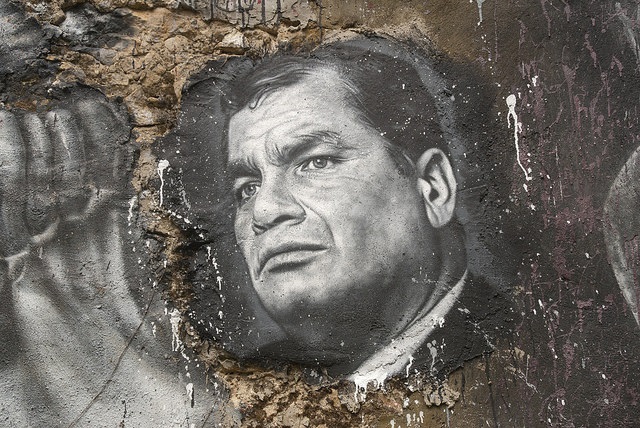
Photo Credit: Thierry Ehrmann / Flickr / Creative Commons

Photo Credit: Thierry Ehrmann / Flickr / Creative Commons

What seemed like a certainty less than a year ago – Ecuadorian President Rafael Correa as a shoo-in for reelection in 2017 – now has given way to competing scenarios as the country’s economic crisis deepens.  The game-changer has been the collapse in revenues from Ecuador’s principal export: petroleum.  With prices for Ecuadorian crude hovering 50 percent below their 2014 average, Correa has had little choice but to slash the abundant government spending that has been the hallmark of his presidency.  Ecuador’s use of the U.S. dollar greatly handicaps its capacity to adjust.  Further aggravating the recession is the economic downturn of Ecuador’s principal external lender, China.  Over $2 billion have been cut from the 2015 budget, and plans to shrink the size of the public bureaucracy are now under way.  His decision in April to suspend the central government’s obligatory payments to the national social security system stoked anxiety about the fund’s future, and an announcement in June of plans to hike taxes on inheritance and real estate transactions sparked street demonstrations around the country.  Indigenous and labor organizations mobilized in mid-August to protest these and other aspects of Correa’s style of governing.  An estimated crowd of 100,000 people marched in Quito.  Scores of protestors were detained and face charges related to the August mobilizations.

The months ahead will not be easy for a president accustomed to buoyant budgets and strong polls.  As one of Latin America’s left-turn leaders, he pushed a state-centric economic model under which poverty declined and the middle class grew.  His approval ratings since he took office in 2007 consistently scored among the highest of any Latin American president.  (They dipped below 50 percent – as low as 42 percent – for the first time in 2015.)  While Correa waxes and wanes on whether he really will pursue reelection, his party is pushing to amend the Constitution through legislation – without a referendum supported by over 80 percent of the public – to allow him a third term.  The opposition strenuously opposes the move.  The National Assembly appears headed toward a final vote on the matter in December.

From now until December, the reelection maneuvering and two possible outcomes will dominate conversations.  Under one scenario, Correa and Alianza País will push ahead with the amendment, ignoring negative public reaction and repressing protests if necessary, and Correa will decide on his candidacy depending on his view of the economy and the state of the opposition.  In a second and perhaps less likely scenario, Correa and his party may just abandon the reelection plan, concluding that the political costs are just too high.  This would set off power struggles within Alianza País over who would head the ticket.  Among the prospective frontrunners are former Vice President Lenín Moreno, current Vice President Jorge Glas, Production Minister (and former Ambassador to the United States) Nathalie Cely, and former Industry Minister-turned-critic Ramiro González.  In the process, Correa will be looking to anoint someone loyal and capable of governing the country until he can return as a candidate in 2021.  Under both of these scenarios, Ecuador is bracing for a volatile year ahead.  Natural disasters – a possible volcanic eruption of Mount Cotopaxi and El Niño – could also fuel uncertainty, giving Correa a chance to shine and rally, or to fail and deepen doubts about his leadership.  After eight years of relative political stability and economic good times, Ecuadorians are pondering whether a post-Correa era could be at hand and what it would mean.

September 8, 2015

* Catherine Conaghan is the Sir Edward Peacock Professor of Latin American Politics at Canada’s Queen’s University and a former CLALS Research Fellow.

Guatemala’s Crisis is Not Over

By Eric Hershberg*

Guatemala City, August 2015. Photo Courtesy of Eric Hershberg.

Guatemala City, August 2015. Photo Courtesy of Eric Hershberg.

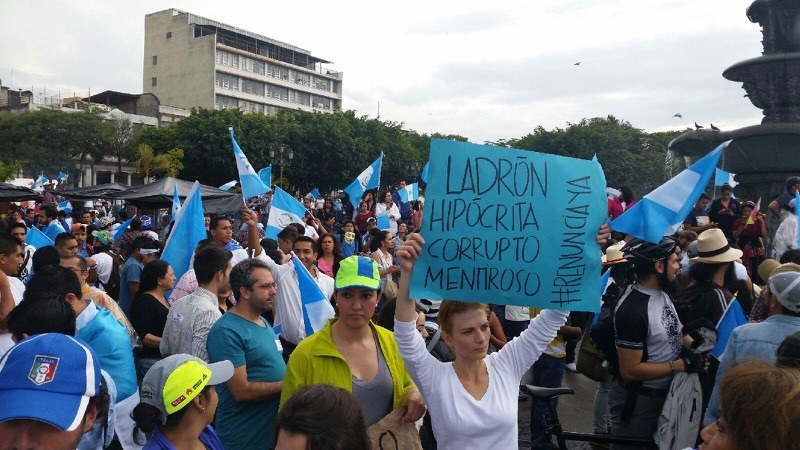
With President Otto Pérez Molina’s resignation early this morning, Guatemala lurches into a new phase in its long-running political crisis, with little prospect that this weekend’s elections will resolve much.  The investigations into the Pérez Molina administration’s corruption, the national assembly’s unanimous vote to suspend his immunity, and the peaceful surge in popular protests demanding that he step down all suggest progress in the country’s efforts to build a functioning democracy.  The UN-sponsored Comisión Internacional Contra la Impunidad en Guatemala (CICIG) fulfilled its mandate, and its example and training were arguably important factors in the ability of judicial officials in Pérez Molina’s own government to support the processes that led to his downfall.  (Click here for an AULABLOG assessment of CICIG in May.)  The Congressional vote to strip him of immunity was unanimous, including even his most loyal supporters, who until then had rejected popular clamoring for the president’s ouster.  By the end of last week societal disgust with the political elite had reached the point that even the most recalcitrant of incumbents realized that their own survival required ditching the president.  The comptroller’s office called on him to resign “to avoid greater social unrest that could have unpredictable consequences” – a sentiment echoed by powerful business groups and the Catholic Bishops Council.

The Guatemalan Constitution and laws lay out the next steps.  The Congress has accepted the resignation, clearing the way for Vice President Alejandro Maldonado – who replaced Vice President Roxana Baldetti after she was jailed in connection with the same corruption scandal – to take office.  The first round of Presidential elections, with 15 candidates in the running, will proceed as scheduled this Sunday, despite calls from some civil society organizations to delay the balloting on grounds that the campaign regulations reflect the influence and interests of criminal elements.  In all likelihood, a runoff round will be necessary six weeks later (October 25).  The convulsions of recent months and deep distrust in government suggest that tensions will be high between now and then, but there’s no indication yet that civil unrest could threaten the electoral process, and military intervention appears to be a thing of the past.  There is every reason to expect that a new President will be inaugurated on January 14.

The elections are unlikely, however, to lead Guatemala into an era of less corruption and greater accountability, or to install leadership willing or able to spearhead economic and social policies to enable the majority of the population to live with dignity.  The slogans on the banners of the tens of thousands of protestors in Guatemala City’s central square lacked any message beyond a rejection of the status quo.  “Throw them all out” and “I have no president”are potent rallying cries but do not address the core challenges of a country where the elite pay no taxes, half of all children are malnourished and tens of thousands of young people desperately seek better lives anywhere other than Guatemala.  

The reputations of the leading candidates and their failure to articulate coherent governing platforms give little room for optimism.  Leading in the polls is a wealthy businessman, Manuel Baldizón, whose running mate is already being investigated for corruption and whose own closet is widely understood to contain plenty of skeletons.  Protestors have already singled out Baldizón as unacceptable, taunting him with chants of “it’s your turn next.”  In second place is a comedian named Jimmy Morales, who enjoys the support of the economic elites and media but has advanced no policy platform whatsoever.  Former first lady Sandra Torres appears to be running third.  She divorced President Álvaro Colom in 2011 to circumvent a court ruling that, as First Lady, she couldn’t run for office.  (The Constitutional Court put a final stop to her campaign a month before elections that year.) 

Electoral victory by any of these candidates would leave Guatemala with weak leadership at a time that most government institutions desperately need revitalization.  Corruption is too deep-rooted for CICIG and its few allies in government to face down alone, and these candidates won’t use the presidency to carry out the needed purge.  The organized criminal groups that traffic drugs and persons through the country and permeate governing institutions stand to grow only stronger, and the misery that plagues a population deprived of education, health care and jobs will continue unabated.  U.S. Vice President Joe Biden’s billion-dollar aid package for Guatemala, Honduras and El Salvador, already in trouble in Washington, may have nowhere good to go.

September 3, 2015

*Eric Hershberg, director of the Center for Latin American & Latino Studies at American University, witnessed the protests in Guatemala City last week.

Journalism in Cuba: Unstoppable Change

By John Dinges*

Jaume Escofet / Flickr / Creative Commons

Photo Credit: Jaume Escofet / Flickr / Creative Commons (modified)

Cuban journalism is changing rapidly – both in and outside the official media.  Developments in media reflect the dynamic changes taking place in Cuba and are likely to drive even deeper change in the future.  Journalists outside the system have long been seen as eager to create alternatives to the centrally controlled media that have dominated for decades.  Now, although many inside the government-run media still generally seek continuity of the Cuban revolution, a timid but slowly growing number of them are showing signs of openness to shifting away from their traditional role as a propaganda machine for a one-party state.  Together, the non-official and official journalists are part of a process of change that is robust, unstoppable, and healthy from the perspective of journalistic values.  Among the indicators:

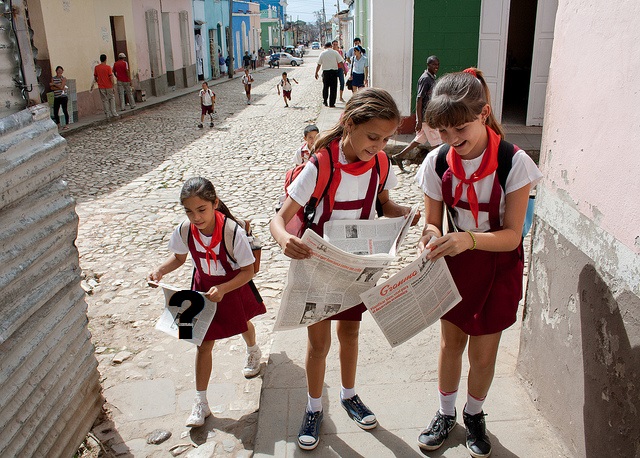
  • The official Communist Party daily, Granma, now dedicates a page each Friday to letters from readers with a host of complaints about daily life – inefficiency of government offices, long lines at stores, and delays in government benefits. In Cubadebate and other official blogs, there are been numerous analytical articles that could be called “loyal criticism.”
  • Yoani Sánchez – a star among the non-governmental bloggers – and others are sharp critics of the lack of political freedoms and proponents of radical but peaceful change. Their audience in Cuba is small, because of low connectivity on the island, but their voices occupy an important part of the spectrum of the country’s new journalism.
  • A new kind of media – individuals who identify as journalists and not as political dissidents – appears likely to have an even greater impact. The most successful of these, OnCuba, is a glossy bimonthly magazine distributed on the daily Miami-Havana charter flights.  It runs commercial covers – one recently featured a woman smoking a Cohiba – but also carries articles on sensitive political and economic issues.

OnCuba is an extraordinary experiment launched three years ago by Cuban-American businessman Hugo Cancio and employing 12 full-time Cuban journalists in a well-appointed Havana office – all with the necessary Cuban government approvals.  The editors say the publication’s only objective (other than paying its bills) is to serve as an intellectual bridge between Cubans in Cuba and Miami, casting a critical eye to both.

OnCuba and its nascent genre probably judge that walking the line between the two extremes – rejecting both “officialist” and “dissident” labels – increases their chances of landing on their feet if and when deeper change occurs in Cuba.  A recent episode involving leaked government documents, however, underscored the complexity of their balancing act.  An independent blog called La Chiringa de Cuba published a PDF of a sensitive Ministry of Communications plan to massively expand broadband access in Cuba by the year 2020, and OnCuba prepared a long article describing and analyzing its importance.  Despite the importance of broadband for the nation, the official media have so far neither reported on the leak nor – importantly – have they condemned it.  While the course of all these changes is uncertain, one thing beyond doubt is that, when it comes to journalism in Cuba, it’s now “Game on.”

June 19, 2015

*John Dinges teaches journalism at Columbia University and is the author, among other titles, of “The Condor Years: How Pinochet and his Allies Brought Terrorism to Three Continents” (The New Press 2004).

Civics Lessons from Guatemala

By Robert Brenneman*

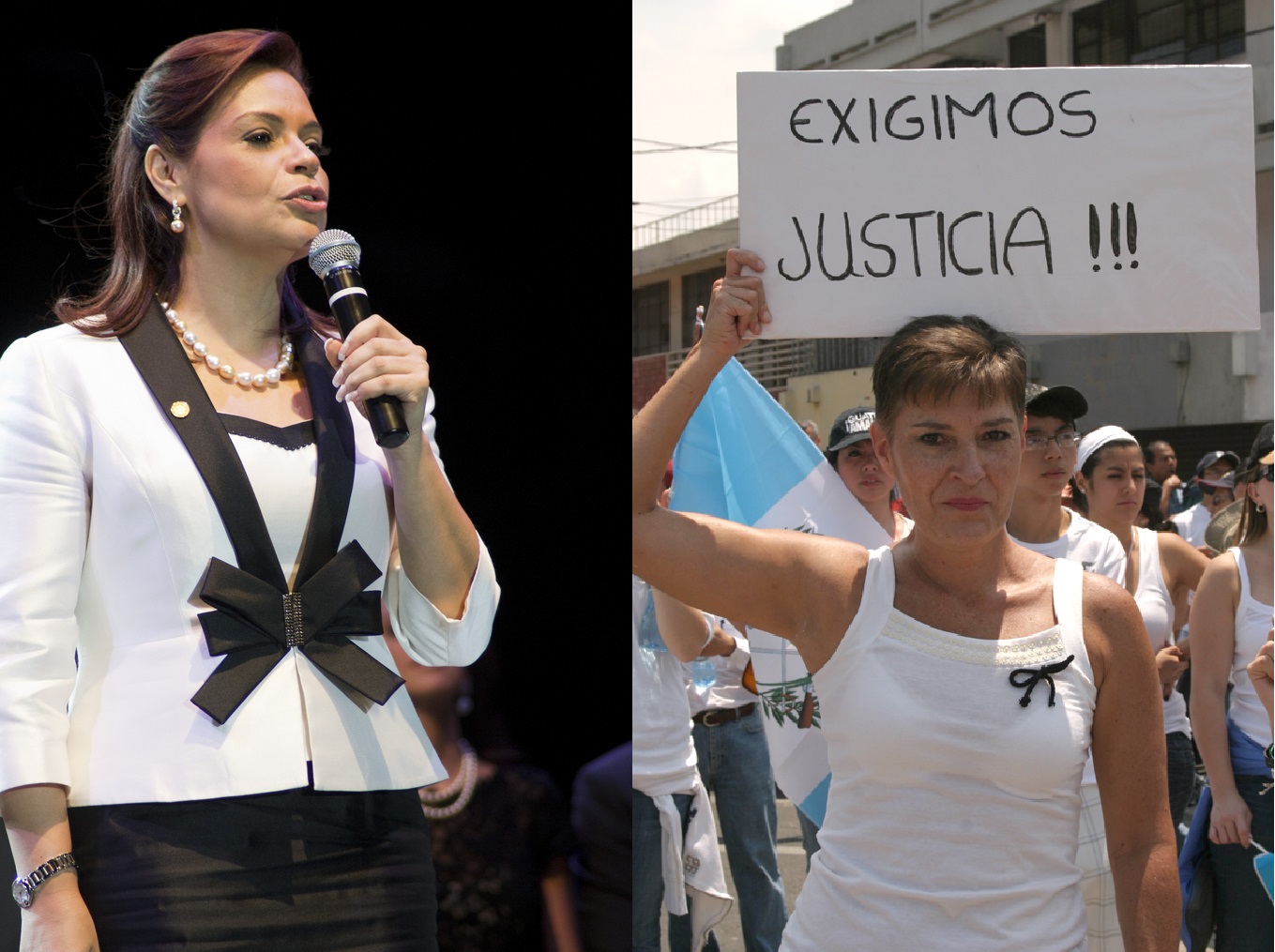
Former Vice President of Guatemala Roxana Baldetti (l) and a protestor with sign "We demand justice" Photo Credits: Surizar / Flickr / Creative Commons

Former Vice President of Guatemala Roxana Baldetti (l) and a protestor holding sign that proclaims “We demand justice.” Photo Credits: Surizar / Flickr / Creative Commons

Guatemala’s popular movement for justice and transparency is suddenly and happily discovering that nothing breeds success like success.  Many Guatemalans have grumbled for years about rampant corruption among the political class, but in recent weeks a surging popular movement has finally emerged giving voice and energy to years of that frustration with impunity and graft.  The movement picked up steam after a public exposé of a shadowy tax fraud and contraband network called “La Línea,” orchestrated out of Vice President Roxana Baldetti’s office by her private secretary.  The report was produced by the International Commission against Impunity in Guatemala (CICIG).  (Click here for analysis of the Commission’s renewal.)  President Pérez Molina not only renewed CICIG’s term until 2017; on May 7 he also accepted the resignation of Baldetti and her secretary, who had served as the key money-raising dealmakers for his administration.  The U.S. Embassy suspended the visas of many of the officials named in the report, including the luckless former vice president herself.

These actions have not been enough to appease the appetite for justice and transparency sought by the growing crowds of flag-waving nonviolent protestors converging each Sunday afternoon in front of the Guatemala City’s Municipal Palace.  An estimated 57,000 gathered under thunder and pouring rain on May 17.  Empowered by the relatively swift impact of their movement, and outraged by the mounting evidence pointing to the president’s personal connections to the corruption network, the crowds of protestors  led principally by students of the public university  have shifted to demanding that the president himself step down.  Pérez Molina, sensing that the wheels are coming off his administration, has requested the resignations of his closest advisors and top officials, including his Interior Minister and his Chief of Strategic Intelligence.  He has revoked or rescinded several of the most lucrative (and obviously corrupt) government contracts that he had vociferously defended only a few weeks ago.

President Pérez Molina’s political future remains up in the air.  Many Guatemalan political analysts believe he should step down.  José Rubén Zamora, founder of Guatemala’s influential daily El Periódico, argues that resigning is “the only way out of an impossible labyrinth” of the president’s own making.  But many others view the president’s fate as less important than whether the country takes advantage of the opportunity to use public pressure to pass sorely needed structural reforms.  For years Congress has ignored several bills that would tighten campaign finance rules and bring transparency to government contracting.  Since pay-to-play politics is not unique to this administration, fixing the problem will require legal and structural changes, not merely changing the nameplate on the presidential suite.  One hopeful sign is that Manuel Baldizón, leader of the opposition Renewed Democratic Liberty Party (LIDER), has not managed to coopt the popular outrage to kickstart his own election campaign.  A popular banner at the protests warns him “¡No te toca!” (“It’s not your turn!”).  The leaders of the movement recognize that Baldizón – who has many skeletons in his own closet and heads another investment-financed party – is hardly the answer.  The protesters’ focus on reform rather than politics suggests that the most certain – and long-lasting – outcome of all is the strengthened civic sphere that appears to have emerged as the protests grow and the newspapers report daily arrests and resignations.  In this civics lesson, the Guatemalan public is both pupil and teacher.

May 26, 2015

*Dr. Brenneman teaches sociology at St. Michael’s College and is author of Homies and Hermanos: God and Gangs in Central America (Oxford University Press 2012).

Ecuador: Stacking the Deck Against Democracy

Enlace Cuidadano

Ecuadorian President Rafael Correa during one of his weekly broadcasts Enlace Ciudadano / Mauricio Muñoz / Flickr / Creative Commons

By Catherine M. Conaghan*

Taking a page from Hugo Chávez’s playbook, Ecuadorian President Rafael Correa is intimidating and steadily increasing controls on his opponents.  He regularly uses his Saturday morning broadcasts to name and shame them.  Actors from all walks of Ecuador’s civil society – journalists, lawyers, activists, academics, bloggers, union and social movement leaders – have been the target of his insults and thinly veiled threats on the weekly program, Enlace Ciudadano.  In February, Correa’s show was skewered by HBO comedian John Oliver – and, to Oliver’s delight, Correa fired back by tweeting insults (click here and here).  Journalists and civil society leaders applauded Oliver for drawing attention to the continuing deterioration of civil liberties in Ecuador.  Correa’s virulent rhetoric and intimidating use of media is part of a larger matrix of policies endangering freedom of expression and association in Ecuador.  Over the last two years, the Correa administration has worked methodically to mount a legal framework allowing for greater government control over the media and civil society organizations.

  • The 2013 Law of Communication and a new oversight agency, the Superintendence of Information and Communication, are intended to ensure that all print and broadcast media provide “truthful information” that is “verified, contrasted, precise, and contextualized.”  Superintendent Carlos Ochoa was selected from a short-list of nominees provided by Correa.  Among alleged violations recently singled out for sanctions are items in the leading newspaper El Universo and its accomplished political cartoonist, Xavier ‘Bonil’ Bonilla.
  • Issued in 2013, Executive Decree 16 also has civil society – from neighborhood associations to think tanks, business chambers, unions, and advocacy groups – under pressure. In addition to elaborate regulations for the legal registration of organizations, the decree stipulates conditions allowing the government to “dissolve” them.  These include group involvement in “partisan activity” and “interfering in public policies.”  To date, only one organization – the Fundación Pachamama involved in environmental activism – has been dissolved, but civic leaders fear that the decree will induce ”self-censorship” and stifle participation.

The new laws amount to a project – unprecedented for Ecuador – of surveillance and regulation.  They provide the government with a tempting arsenal of weapons to use, if necessary, in upcoming battles on other important legal matters, especially on the issue of presidential re-election.  After years of pledging that he would not seek a third term in office, Correa reversed course and has tasked his legislative super-majority with finding a swift route to amending the constitution.  Most public opinion polls show, however, that a majority of Ecuadorians would prefer a referendum to decide whether or not yet another consecutive re-election should be allowed.  The road to re-election may be more difficult than Correa and his advisors imagine, but they enter the fray with the weight of the law on their side.  With powers to control the media and limit the activity of civil society, the Correa administration enjoys the upper hand as 2017 approaches.

March 12, 2015

*Catherine Conaghan is the Sir Edward Peacock Professor of Latin American Politics at Queen’s University in Kingston, Ontario.  She specializes in Andean politics.  She is the author of an article, “Surveil and Sanction: The Return of the State and Societal Regulation in Ecuador,” in the April issue of the European Review of Latin American and Caribbean Studies.

Nicaragua’s “Great Canal” Draws Opposition

By Fulton Armstrong

9036608152_a199acb183_z

Protestors opposing the Chinese-Nicaraguan canal confront police / Jorge Mejía Peralta / Flickr / Creative Commons

Although questions continue to swirl around whether the Chinese-Nicaraguan canal – which its main investor called the “most important [project] in the history of humanity” – will be built or not, its opponents are taking it all very seriously.  A CID-Gallup poll in January showed that 41 percent of Nicaraguans interviewed strongly support the project, while another 21 percent and 17 percent back it somewhat and a little, respectively.  But another poll by the same firm suggested ambivalence:  asked if they supported the National Assembly vote giving the Chinese firm leading the project, HKND, a concession for the 278-km right of way for up to 100 years, some 39 percent of respondents said no.  Some political voices are growing more sharply opposed as well.  The powerful business group COSEP, for example, has gone from agnosticism about the project to a position of open disapproval.

Groups concerned about the project’s impact on the environment and rural residents have already held protests involving up to several thousand participants, and – despite the government’s promise that the canal will bring prosperity throughout the country – organizing efforts appear unlikely to fade.  Skepticism about HKND and the government’s commitment to protecting the environment, fueled by their off-the-cuff dismissal of concerns, is so deep that even a balanced comprehensive impact study by the British Environmental Resources Management, due next month, may fail to calm nerves.  Environmentalists cite studies warning that dredging Lake Nicaragua from its current depth of nine meters to the 27 meters necessary for cargo ships will stir up many layers of toxic materials, with catastrophic consequences for marine life and surrounding agricultural areas.  Other groups are rallying behind the 29,000 residents who are to be evicted from properties along the canal route.  Demonstrations have turned violent, with protestors injured by tear gas and rubber bullets.  Graffiti and banners demanding “fuera chinos” are common.

In the hemisphere’s second poorest country, the promise of growth spurred by the $40-50 billion project is still a powerful card in the government’s hand.  Many skeptics still wonder, however, if the whole scheme is a ruse to fleece the Chinese investors, who’ll bring in a couple billion dollars before realizing that the project will get bogged down in Nicaraguan political quicksand.  But opposition to the canal goes far beyond the usual Managua political game of fighting over corruption dollars and obstructing each other’s priorities.  President Ortega’s endorsement of the canal contradicts his own statements years ago that he wouldn’t compromise the lake’s eco-system “for all the gold in the world.”  According to The Guardian newspaper, the dredging will move enough silt to bury the entire island of Manhattan up to the 21st floor of the Empire State Building – which no one is prepared to deny will have serious environmental implications.  China’s Three Gorges Dam, completed five years ago, displaced 1.2 million inhabitants – proportionally twice as many Nicaraguans displaced by the canal – but Nicaragua’s ability to resettle them, give them jobs, and suppress their dissent is small compared to China’s.  The project may not be the greatest in the history of mankind as HKND claims, but it may provoke a crisis as great as any in Nicaragua.  For starters, if COSEP’s opposition persists, it threatens to unravel the modus vivendi under which Daniel Ortega has stayed in power, and could portend much deeper tensions.

March 5, 2015

Click here to see our previous article about the canal.

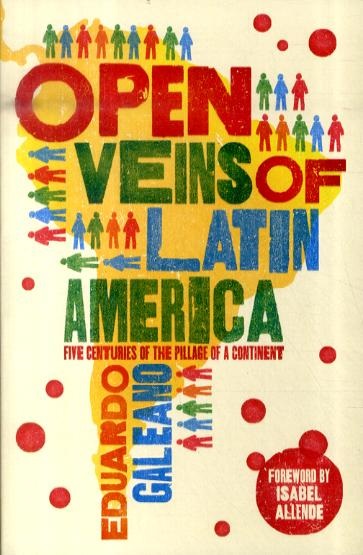
The Open Veins of Latin America: Disowned?

By Núria Vilanova

tintincai / Flickr / CC BY-NC 2.0

tintincai / Flickr / CC BY-NC 2.0

Forty-three years after its publication, the emblematic and widely read Latin American anti-colonialist bestseller The Open Veins of Latin America has been disowned by its creator, 74-year-old Eduardo Galeano – but its literary message remains vital.  Interviewed last May about the book often called the “Bible of the Latin American Left,” Galeano said, “I don’t regret having written it, but it belongs to a time that to me has been overcome.”  His words left a sense of abandonment and deceit among many, who asked:  What had happened to the bleeding veins of Latin America drained by European and U.S. colonial powers?  Hadn’t the region been sacrificed since Columbus to profit diabolic foreign interests?  When Venezuelan President Hugo Chávez gave President Obama a copy of the book in 2009, was he clinging to an interpretation of Latin American history no longer embraced by the region’s leading thinkers?  Others asked, however well-deserved a denunciation of the exploitation and oppression laid out in the book was, were they to be blamed for all of the damage inflicted in the region?

Galeano’s interview signaled a refocussing of his analysis rather than wholesale rejection of it.  He said Open Veins was too boring and written in a tedious style and with the doctrinal tone of the traditional left.  He added that in those early days of his career he did not know enough politics and economics to write a book of such reach.  What Galeano has demonstrated by this unassuming recognition is that he has evolved through the years and, like many others, realizes that the dependentista paradigm, with its rejection of western capitalism, that fueled his book had important shortcomings, and overlooked other key problems.  He underestimated the impact of weak institutions – anticipated by Bolívar in the early 19th Century – and internal political and economic issues such as government corruption and the unwillingness of the ruling classes to contribute to the development of more democratic and egalitarian societies, as Marx himself would argue when writing about Southern countries.

The real – and not insignificant – value of Open Veins today lies in its literary character.  Its capacity to capture the spirit, the hope and the rage of those turbulent times in the region lives on.  Filled with metaphors and symbolism, it is an essay, whose literary dimension makes it current and ageless.  Stemming from a deep Latin American tradition, the book crosses the blurred borders between literature and history, sociology, politics and other disciplines alike.  Like José Martí, Ricardo Palma and Octavio Paz, Galeano attempted to transgress the boundaries between literature – subjectivity, imagination and hyperbole – and disciplines based on empiricism and factuality.  This practice can lead to challenges over facts, but the messages remain compelling.  Elizabeth Burgos’s testimonial account of Mayan activist Rigoberta Menchú in I Rigoberta Menchú (1984) was criticized for alleged inaccuracies, yet it is difficult for anyone to deny that the suffering of the Mayan Quiché community in the 70s and 80s was at least as cruel as Rigoberta depicted in the book.  Carlos Fuentes once said that reality will always overpower fiction, no matter how hard writers tried.  The intellectual evolution that Galeano has displayed is welcome, and it is also an inspiration to reread Open Veins and Latin America with much-needed fresh eyes.

December 2, 2014