The Catholic Church as a Field Hospital after Battle

By Alexander Wilde

Pope Francis / Photo credit: Catholic Church (England and Wales) / Foter / CC BY-NC-SA

Pope Francis / Photo credit: Catholic Church (England and Wales) / Foter / CC BY-NC-SA

Pope Francis is presenting a fresh and personal vision of the Catholic church and Christian faith that seems likely to breathe new life into the church in Latin America.  In a long interview released last week, he couched his message in terms appropriate to his global responsibilities, but it reflects how this first Pontiff from Latin America reads the recent history of his native region and its church. “I see the church,” he said, “as a field hospital after battle.” Having lived through several generations of often bitter conflict and traumatic violence, he clearly believes that the church must, in his words, “heal the wounds, heal the wounds…. And you have to start from the ground up.” This dramatic, arresting metaphor of the church’s role in ministering to the human condition as he sees it today suggests that he aims to chart a fresh course – in the church and in society – after the divisions that marked the papacies of his two immediate predecessors. “The image of the Church I like,” he said in language that echoes the Second Vatican Council (1962-65) and Latin America’s Liberation Theology, “is that of the holy, faithful people of God…on the journey through history, with joys and sorrows.”

This vision seems firmly rooted in his own experience as Jesuit Provincial and Archbishop in Argentina, where despite controversies over his actions or inactions during the 1976-1983 dictatorship, he is universally admired for his dedication to pastoral ministry. With this fundamental focus on those wounded by life, Francis will build on a foundation that already exists in Latin America today. Despite the notorious purges of liberationist tendencies in church structures that began in the 1970s, priests, nuns and lay people can be found throughout the continent living out pastoral vocations amidst new (and old) forms of violence at the grassroots. Francis will almost certainly, like his predecessors, affirm most doctrinal orthodoxies, such as the intrinsic value of even unborn human life (“I am a son of the Church”). But already his pastoral emphasis is a clear break: “The people of God want pastors, not clergy acting like bureaucrats or government officials. The bishops, particularly, must … be able to accompany the flock that has a flair for finding new paths.”

Francis thinking is permeated by concepts and practices that come from the Council, Liberation Theology and the pastoral experience of the Latin American church. He clearly hopes to move beyond old divisions and draw from what that church has learned to meet the regions challenges today. Those include a challenge to convey the churchs deepest truths of salvation in ways that Evangelical Protestants have done so successfully in the region. And it is not coincidental that he urges, We need to proclaim the Gospel on every street corner. He will, undoubtedly, be opposed by conservatives that dominate the church’s ecclesiastical structures (resisting, for example, new paths of policy advocacy by the faithful on issues of poverty and inequality). His new appointments to gatekeeper roles such as nuncios and bishops will be closely watched. He has also inherited an institution shamed by sexual and financial scandals that will demand much of his time and energy. But in just a few months Pope Francis has changed perceptions among Christians and non-believers alike of how the Catholic church may again become a vital force in our world today. In Latin America a new emphasis on face-to-face pastoral ministries among the poor could well move its moral voice for social justice behind already visible popular pressures against growing economic inequality.

Alexander Wilde directs the Center’s two-year project on Religious Responses to Violence in Latin America with support from the Henry R. Luce Initiative on Religion and International Affairs.

Emerging Engines for Latin American Economies? The Potential of Cultural and Creative Industries

By Robert Albro
Associate Research Professor, CLALS

Filming in Chile / Photo credit: Patt V / Foter / CC BY-NC-SA

Filming in Chile / Photo credit: Patt V / Foter / CC BY-NC-SA

In global terms Latin America’s economy is expected to grow at a relatively brisk 4% in 2013. In the medium-term, however, the picture is not as rosy, since this growth is largely sustained by the export of natural resources and raw materials, the demand for which is expected to slow. If Latin America hopes to continue to enjoy economic growth and stability, other sectors will need to emerge. One strong candidate is cultural and creative industries, a sector that includes all copyrightable entertainment, education, information, and other cultural goods and services, like film, T.V., music, or video games, but also tourism and local heritage products. One of the world’s fastest growing sectors, it has quadrupled its share of world trade since 1995. In 2012 it represented an estimated $2.2 trillion, or 11% of the global total. Cultural and creative industries are also seen as largely immune to the ups and downs of the business cycle. At the height of the recession in 2008, global trade declined by 12%, while trade in creative goods increased by 14%.

Signs that the creative industries are taking off in Latin America are widespread. As the 2010 Creative Economy Report noted, regional governments are now actively promoting policies for this sector, including to incentivize tourism, create new cultural infrastructure, and increase intellectual property protection. South America’s MERCOSUR Cultural, a regional network of over 400 institutions, is centralizing country-based cultural data. Latin America’s film industry is resurgent, with more than 600 million gate receipts last year, and in 2011 Mexico’s television content distribution business alone topped an estimated $251 billion. As a burgeoning tech start-up hotspot, Chile has also become an important video game incubator. Buenos Aires’s design industry is a global player with double digit growth that accounts for 3% of Argentina’s total economy. Designated a UNESCO “creative city” in 2012, Bogotá is now the focus of major government investment as a center of music innovation. Meanwhile, in Brazil the new Creative Rio Program has been launched to enhance that city’s creative economy.

If there is cause for optimism, significant barriers remain. Cities rather than countries are the critical units of scale, as cultural platforms and global nodes in an emerging information economy. But the persistent lack of citizen security across Latin America’s cities is likely to undermine the sustainable development of this sector. The creative industries are also highly unevenly distributed throughout Latin America. Audiovisual production, for example, is limited to Argentina, Mexico, Brazil, Colombia, and Venezuela. Cultural goods and services, too, can become vehicles for regional concerns about the threats posed by globalization, leading to trade frictions. Most importantly, a thorough assessment of the organization and diversity of the region’s cultural and creative industries has yet to be done, debilitating future strategic decision-making. Assessment of this sector is undermined by inadequate or incomplete metrics. But even with metrics in hand, how to make best sense of these in ways that account for the exceptional status of cultural goods as key sources of collective identity, community well-being and quality of life remains a real challenge, one which CLALS is currently partnering with the Inter-American Development Bank to address.

Transgender Rights: Signs of Progress in Latin America

By Emily McGranachan

Marcha de Orgullo, Buenos Aires, Argentina / Photo credit: blmurch / Foter.com / CC BY

Marcha de Orgullo, Buenos Aires, Argentina / Photo credit: blmurch / Foter.com / CC BY

Social and structural discrimination limit the economic, health, and social prospects of transgender individuals, often leading to precarious lives fraught with human rights violations.  According to Argentine psychologist Graciela Balestra, transgender people around the world have an average life expectancy of only 30 years.  In Latin America, they have the highest rate of HIV infection (35 percent) and frequently face violence and insecurity.  According to the 2012 Trans Murder Monitoring Project report, of the total reported murders of transgender people in the world between 2008 and 2011, 79 percent took place in Latin America.  International HIV/AIDS Alliance and Red Latinoamericano y del Caribe de Personas Trans (REDLACTRANS) published similarly startling statistics in a 2012 report titled “The Night is Another Country.”  While the report focused on the experiences of transgender women, it also reveals that transgender men also experience high rates of discrimination and violence throughout Latin America.  Of the transgender women interviewed in the study, about 80 percent reported experiencing violence or threats by police and other officials.  Throughout Latin America the prevalence of transphobia – defined as the fear or hatred of transgender people – has led to impunity for violence and discrimination against transgender people, and these crimes, including murder, are seldom prosecuted.  The transgender community also faces challenges of social discrimination and the lack of access to health care and jobs, marginalizing transgendered people in society.

While the current situation is stark, some societies have shown greater openness to transgender people.  Whereas Brazil and Colombia allow identity card changes only after surgery and board evaluation, Argentina in 2012 became the first country in Latin America to pass a progressive law easing the rules with regard to gender identity and identification.  Now a person in Argentina can change the name and sex on their identity card without having to go through the long and discriminatory process of sex reassignment surgery or going before a judicial review board.  In 2009, Uruguay slightly loosened its controls when it began requiring only board approval for identity card changes.  Government initiatives, like that of Argentina, have direct impacts on the lives of transgender people, who are able to access jobs and other securities, according to Balestra.  Greater inclusion in society and stronger legal protections by the government can signify or signal a change in social values within the broader society.

The Obama Administration has been a vocal supporter of LGBT (Lesbian, Gay, Bisexual and Transgender) rights as part of a broader human rights agenda in international diplomacy.  Among its initiatives are the Global Equality Fund to support local LGBT organizations and advocates, a greater recognition of refugee rights for LGBT people, and a general promotion of rights abroad through working with NGOs and states.  Recognizing the situation in Latin America, the State Department highlights its work trying to establish a special rapporteur for LGBT human rights within the Inter-American Commission for Human Rights.  As some aspects of LGBT rights progress in the United States (the U.S. still has a high rate of violence against transgender people as well), it is expanding its understanding and definition of human rights.  While the right to security, health care, employment and dignity have long been international human rights, only recently has the discrimination and violence transgender people face become an important part of the human rights platform.  The incorporation of LGBT human rights into U.S. foreign policy, backed by a strong U.S. example of justice and security for transgender citizens, will encourage other countries to follow suit. 

Finding New Approaches to Media-Government Tensions in Latin America

By John Dinges

Press Conference in Lima, Peru Photo credit: World Economic Forum / Foter.com / CC BY-NC-SA

Press Conference in Lima, Peru Photo credit: World Economic Forum / Foter.com / CC BY-NC-SA

Establishment news media and government are on a collision course in a number of Latin American countries.  At the heart of the conflict is government rejection of the classic role of an ideologically diverse press as a check on government power and as a forum of citizen deliberation.  The media, in response, charge that government actions constitute violations of international free press guarantees.  But that defense has been ineffective and has not resonated at the popular level.  All of the governments involved are democratically elected, and most espouse left-of-center programs of progressive reform aimed to benefit the poorest sectors and address other forms of inequality.

The most severe conflicts are in Venezuela and Ecuador, where aggressive government use of laws and lawsuits has dramatically diminished the influence of independent television and newspaper organizations.  The once strident news media, not unfairly characterized as the de-facto opposition, have been cowed, and are cowering.  At the same time, governments are embarking on the redistribution of the broadcast spectrum to favor community and state-owned (“public”) channels.  The Morales government in Bolivia has achieved the upper hand over the media as it builds its own media network.  The Kirchner government of Argentina is fighting a legal battle –with mixed success – to cripple the media empire of Grupo Clarín, the owner of the largest newspaper in Latin America and the largest cable network.  The conservative governments of Honduras and Panama are also on the freedom of expression watch list, indicating that the phenomenon is not purely a matter of ideology.

The polarization and growing government dominance represents a serious problem for democracy in these countries.  For all the harsh rhetoric on both sides, however, the overall threat to freedom of expression (measured in censorship, direct control of media and imprisonment of journalists) is far less than was the case during the rightist military governments of previous decades.  Still, it would be a mistake to limit our promotion of healthy democracy to the defense of the traditional “legacy” media institutions in these countries.  Government leaders, especially Presidents Correa of Ecuador and Kirchner of Argentina, have used (some would say misused) democratic arguments in criticizing the traditional media.  They charge that the concentration of media in the hands of the private sector (with ownership participation of banks in the case of Ecuador) is itself a violation of democracy, and that they are trying to “democratize” the media by delivering increased access to citizens in the form of public and community media.  Not surprisingly, these new media creations are beholden to the government and lack political independence.  But they are not going away.  In an effort to defuse the tension, institutions such as the Carter Center and others have developed an alternative conflict resolution approach that is quietly garnering support.  The idea is to promote an honest dialogue between governments and wide sectors of the media.  It would create a process to explore the substance of government positions as well as investigate alleged abuses. To this end, the Carter Center organized meetings earlier this year in Ecuador and Bolivia, and a conference was held at Columbia University’s School of Journalism this month bringing together leaders of government, media institutions and international organizations to debate media regulation and press standards as a platform to reconstitute consensus about media in democratic societies.

The TecnoLatinas: A Start-Up Revolution

Foro de Ahorro de Energía Eléctrica, México | Photo credit: Alejandro Castro | Foter.com | CC BY-NC-SA

Foro de Ahorro de Energía Eléctrica, México | Photo credit: Alejandro Castro | Foter.com | CC BY-NC-SA

Latin America is experiencing a full-fledged start-up movement amid rapid growth of an innovation and information economy.  Over the last several years the region’s online population has grown faster than in any other part of the world – with approximately 255 million internet users as of last year.  Half of the top 10 markets worldwide, ranked by time spent on Facebook and other social media, are in Latin America.  Clusters of innovation start-ups, such as those around Monterrey, Mexico, are springing up with astonishing speed.  In 2012 Mexico was among the largest exporters of information technology services in the world.  Google is currently building a data center in Chile, while Amazon Web Services opened a data center in Sao Paolo last December.  But these are not information-era maquiladoras. Instead, Latin American entrepreneurs are combining the availability of open-source innovation tools and the emergence of cloud computing with effective bridge building in Silicon Valley to bring collaboration, expertise, and capital to their home markets.

  • Latin America offers multiple advantages for tech start-ups: a low cost of development, an educated and growing talent pool with the necessary technical and entrepreneurial skills, and increasingly available and affordable broadband and internet access.
  • In particular, Mexico, Chile, Brazil, Argentina, and Colombia, along with metropolitan areas across the region, are incentivizing the development of a competitive start-up ecosystem – an advantage attracting a growing number of “angel investors.”
  • Start-Up Chile, a national program begun in 2010 with 22 start-ups from 14 countries, offers seed capital, grants, tax protection, space, mentoring, and networking to “accelerate” promising ventures.  Its most recent competition drew 1421 applicants from 60 countries, including from Singapore, London, and San Francisco.

The lack of tech innovation and incentives for start-ups has been an Achilles’ heel of Latin American economies for decades.  If the start-up trend continues, the region could make significant, lasting progress toward narrowing the sizable gap between itself and the most dynamic developing countries, mostly in Asia.  Latin America’s start-up movement is both top-down and bottom-up, with a tech-savvy generation of entrepreneurs not afraid to take risks and to leverage government support, as part of a collaborative business model built on multiple ties to Silicon Valley.  A core challenge will be whether these initiatives are scalable, and whether governments can move away from stale policy debates rooted in antiquated paradigms to move their economies toward the frontiers of innovation of the information age.  Old elites with a lock on traditional industries are poorly positioned to obstruct the phenomenon, but if these emerging innovation hubs are to succeed, at some point they are likely to confront  the entrenched and oligopolistic business practices still prevalent in the region’s energy, telecom, and other sectors.

Pope Francis I: The First Latin American Pope

Pope Francis | Photo credit: Catholic Church (England and Wales) | Foter.com | CC BY-NC-SA

Pope Francis | Photo credit: Catholic Church (England and Wales) | Foter.com | CC BY-NC-SA

What will the first Pope from Latin America mean for that region, home to 40 percent of the world’s Catholics?  Leading scholars – several of them participants in a multi-year research project at American University* – offered insights recently in The New York Times.  Among many factors that they point to as conditioning the leadership of the newly elected Pope Francis – Jorge Mario Bergoglio, the former Cardinal Archbishop of Buenos Aires – are how the Church meets the challenge of Evangelical Protestantism and deals with its own past in the region.

With their remarkable rise in recent decades, Evangelicals have broken centuries of Catholic monopoly and made Latin America far more pluralistic religiously than ever before.  Professors Virginia Garrard-Burnett and Daniel Levine underline the limitations of the strategies for renewal employed by the last two Popes – the return to traditional pieties, the adaptation of Pentecostal spiritual practices by “charismatic” Catholics, and the embrace of what Garrard-Burnett calls “neotraditional” organizations such as the elite, secretive Opus Dei.  Levine singles out various Evangelical strengths: churches that “work well with new media, have local leaders close to the community and provide expanded roles for women and minority groups.”  Perhaps the Evangelicals’ most fundamental advantage is their success in making religious faith relevant and real to the millions of Latin Americans that have swelled the region’s violent cities and experienced wrenching social change.

Latin American Catholicism will also be shaped by how it faces its own past in a region where democracies have replaced the dictatorships of old.  The personal story of Pope Francis illustrates different dimensions of that past: an “option for the poor” that took hold after the Second Vatican Council (1962-65) together with a long history of ecclesiastical accommodation with repressive regimes.  The Argentine hierarchy as a whole was seen as supportive of the military dictatorship during the massive violation of human rights in 1976‑83.  Bergoglio’s personal role is unclear.  His supporters hold that he combined pastoral concern for his flock with quiet humanitarian diplomacy toward the junta. His critics argue that he failed to protect several left wing priests and his silence constituted complicity with the regime.  Like many other clerics who rose to dominate today’s Latin American hierarchies, he did not publicly defend human rights.

As Pope Francis, Bergoglio’s personal style and pastoral simplicity already mark an important signal to his Church that it must be committed to the poor.  In Latin America it has a historic opportunity to stand for their dignity and foster their empowerment.  Public identification with their cause is vital, but so is living and working with them to overcome the poverty and violence of their communities.  John XXIII, Paul VI and notable Latin American bishops after Vatican II saw this as a matter of securing their fundamental human rights.  This is an enduring legacy of their leadership during dictatorships that Francis and his Church should build on in the democracies of today.

* 2012-13, with the support of the Religion and International Affairs Initiative of the Henry R. Luce Foundation

Religious Responses to Violence in Latin America

By Alexander Wilde, CLALS Research Fellow

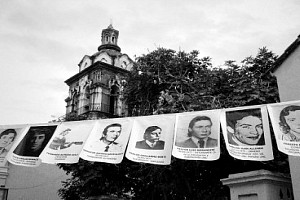
Commemoration of those killed in the 1980's at a church in Cordoba, Argentina | By: Pablo Flores "pablodf" | Flickr | Creative Commons

Commemoration of those killed in the 1980’s at a church in Cordoba, Argentina | By: Pablo Flores “pablodf” | Flickr | Creative Commons

Latin America today is one of the world’s most violent regions. It has been so for 50 years, although the character and agents of violence have changed considerably over time. The “old violence” of the 20th century was largely political, associated with revolutionary insurgencies and repressive regimes that systematically violated fundamental human rights. The “new violence” is largely criminal – illegal drug traffickers and urban gangs are among the leading perpetrators – but its consequences in many societies have been comparably lethal. Countries such as Honduras, El Salvador, Guatemala, Venezuela and Colombia have among the highest murder rates in the world.  “Citizen security” is a leading issue in politics throughout the region.

Religion played a significant part in confronting the old violence.  Human rights became a new cause for the Catholic Church, which in some cases helped legitimate peace settlements and democratic transitions. In the generation since then, Latin American Christianity has been transformed.  Evangelical and Pentecostal churches have achieved unprecedented growth. Catholicism has been reined in by Rome to curb the influence of Liberation Theology. More pietistic and spiritually-oriented theologies have flourished within both traditions. The result has been a tendency to turn away from the “political” ministries of the past – defending human rights and promoting social justice. The Christian churches, it is widely believed, have failed to address the widespread violence of today.

Fresh research, however, is revealing ways in which – although less visible at the national level – they remain a vital force in violence-plagued societies. A two-year project at American University has produced studies of religiously based shelters for Central American migrants in Mexico, a 15-year Jesuit program of peace building and development in Colombia, and an Evangelical prison ministry in Rio de Janeiro, among a dozen pieces of new research. They identify particularly the significance of an active church presence among poor and marginalized populations, who suffer disproportionately from violence. This “accompaniment” appears to be motivated by Biblically-based beliefs about Christian love, the redemptive power of God and the direct experience of living with these populations in perilous, threatening conditions. Another emerging theme in project research is the potential significance of supportive national and international allies – who clearly contributed to the defense of human rights in the past and remain important in our changed, globalized world.

Violence in Latin America today reflects the wrenching changes these societies have undergone in the last half-century, and religion has been a dynamic dimension of those changes. In the region’s civil societies and the lives of its citizens, Catholic and Evangelical Christianity remains a potent and creative presence. Where it is willing to work and live in situations of conflict and violence, it could find a new role in bringing about more stable, peaceful and just societies.

Political Participation in Latin America Expanding

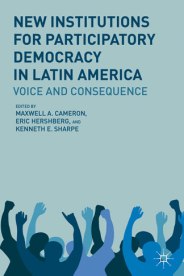
participatory democracy coverFrom local citizen initiatives to national referenda, mechanisms of direct political participation have been spreading with astonishing vigor throughout Latin America in recent years. Some of these mechanisms are new and unprecedented in the way they involve citizens in politics, such as frequently touted participatory budgeting systems at the municipal level in numerous countries.  Other initiatives, such as the National Policy Conferences that consult the citizenry regarding an array of issues in Brazil, are less widely known. In most Andean countries and to some extent elsewhere, these forms of participation often emerge where established representative institutions, such as party systems, have collapsed, or where legislatures have fallen into disrepute.  Yet they also proliferate alongside strong parties, legislatures, and interest associations, as we see in Brazil and Uruguay.

A recent CLALS-sponsored book* examines these new forms of participation and analyzes when they promote, and when not, the consolidation and deepening of representative institutions. The participatory innovations vary along a number of key dimensions, including how they interact with political parties and established institutions, their focus on collective versus individual rights and, perhaps most importantly, their autonomy from political and economic elites.  These differences and their implications are analyzed in detail in case studies on seven Latin American countries: Bolivia, Brazil, El Salvador, Mexico, Nicaragua, Uruguay and Venezuela.

When new forms of political participation emerge spontaneously and independently – as a natural reaction to an unfulfilled need at a local or national level – their voices are authentic and tend to enhance democratic rule.  Brazil’s National Policy Conferences and Uruguay’s referenda to enhance accountability are examples of the incorporation of new voices in policy formulation – to the benefit of the constituencies driving them and the nation as a whole.  We also find instances where participation has exacerbated and reinforced longstanding patterns of clientelism (including in Mexico and Brazil), and autocratic leaders have sought to create or capture such voices to bypass representative institutions (including in Nicaragua and Venezuela).  A valuable lesson of this research, however, is that, once in place, these spaces may become increasingly autonomous. Venezuela’s community councils are an important case to watch: created to reinforce the Chavista project as defined by the Casa Rosada, they may take on a life of their own when the politicians who sponsored them relinquish their positions of power or pass away.

New Institutions of Participatory Democracy: Voice and Consequence, published by Palgrave Macmillan 2012, resulted from a multi-year project co-organized by CLALS and the University of British Columbia’s Andean Democracy Research Network.  More information on the project can be found here .  (The volume has also been published in Spanish by FLACSO-Mexico, Nuevas instituciones de democracia participativa en América Latina: la voz y sus consecuencias)

Top Five Events of 2012

A poll of contributors to AULABLOG identified the following five events (listed below in no particular order) as the most important in Latin America in 2012.  We welcome you to post your own list using the Leave a Comment link below.

By: Matt Westgate "Mettamatt" | Flickr | Creative Commons

By: Matt Westgate “Mettamatt” | Flickr | Creative Commons

Venezuelan President Hugo Chavez’s third major cancer surgery signaled that change – probably profound – will come to Venezuela much faster than his presidential campaign let on.  We expect growing tensions among his aides, none of whom has his charisma or base, as they jockey in a succession scenario.  We’ll be watching whether the PSUV can become an institutionalized mechanism for channeling Chavismo’s support into a governing project in the post-Chavez era.

The election and inauguration of Mexican President Enrique Peña Nieto signals a natural swing back to PRI leadership after 12 years of PAN governments.  Differences over the approach to counternarcotics might flare up in an overall smooth relationship with the United States, but the new president’s biggest challenge is going to be overcoming the persistent economic backwardness that has kept Mexico from achieving the economic growth of others since the turn of the century.

The ouster of Paraguayan President Fernando Lugo last June – as well as the United States and Latin America’s ambivalent reaction to it – was a dramatic illustration that democracy in the region rests on a tenuous foundation of sometimes contradictory constitutions and weak institutions.  The continuing struggle of Honduran President Pepe Lobo, three-plus years after the coup that removed President Mel Zelaya, shows that failure to bring those whose power grabs violate laws and the spirit of law to account sows the seeds of long-term instability and even greater threats to democracy.

The Colombian peace talks, the first serious attempt in 10 years at resolving the decades-old conflict, could lead to a watershed in that country’s development.  President Juan Manuel Santos has shown strong leadership, despite incessant carping from his predecessor, Alvaro Uribe, and has smartly acknowledged that success in the talks is far from certain.  If the talks are successful, 2013 could be a defining moment for a country already experiencing strong economic growth and an important degree of social progress.

Washington continued to sit on the sidelines on most regional issues.  President Obama got a spanking at the Summit of Americas from even perennially friendly governments for Washington’s approach to counternarcotics (overly militarized) and Cuba (stuck in the Cold War).  He was silent on Latin America during the campaign, and his rhetoric of “partnership” and “neighborhood” remained unfulfilled.  Although the President won kudos for implementing elements of the Dream Act by Presidential Directive, the Administration boasted of deporting more than 400,000 illegal immigrants in 2012, the most of any year in the nation’s history.  The region is likely to remain eager for U.S. leadership on issues of mutual interest in 2013, but most countries’ blossoming dealings with Europe, Asia and even Africa suggest they’re not going to sit around waiting for the U.S. to take up the challenge.

Cumbritis and Prospects for Latin American Regionalism

By Carlos Portales
Washington College of Law and Center for Latin American and Latino Studies

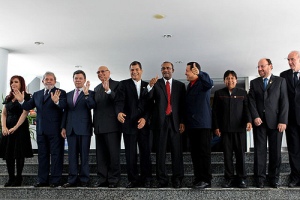
UNASUR Cumbre by  Globovisión | Flickr | Creative Commons

UNASUR Cumbre by Globovisión | Flickr | Creative Commons

Latin America has experienced a veritable proliferation of presidential summits (cumbres) in recent years, an indication of how the hemisphere’s complex web of regional ties is shuffling the landscape of multilateral organizations. This trend was manifested in the Nov. 16-17 Iberoamerican Summit in Cadiz, Spain, followed in quick succession by summits for UNASUR on Nov. 30 and MERCOSUR on Dec. 7. The New Year will witness two summits in Santiago, Chile, the first between the European Union and Latin American and Caribbean States, the second among Latin American and Caribbean States (CELAC).  While sometimes useful in isolation, the cumulative impact of these meetings may be less than the sum of its parts. Indeed, the region may be suffering a bout of cumbritis that is as distortive as it is productive.

The Cadiz summit reflected Spanish determination to sustain an Ibero-American bloc amidst its own profound crisis. Spain’s investments in Ibero-America, particularly in banking and telecommunications, are keeping alive important sectors of the Spanish economy. When the VI UNASUR Summit met in Lima two weeks later, the Presidents of Argentina, Brazil, Venezuela and suspended Paraguay were all absent. Still, the meeting reaffirmed UNASUR’s role in political and military matters: UNASUR was active in the crisis in Paraguay, sent its first-ever electoral mission to Venezuela, the South American Defense Council provides coordination in defense industries and natural disaster responses, and aspires to support protection of human rights.

The following week in Brasilia, MERCOSUR formally incorporated Venezuela and signed an adhesion protocol with Bolivia. However, as Tom Long wrote in “Mercosur’s future: Whither economics?” on Dec. 18, MERCOSUR’s expanding breadth masks a lack of depth. The trade bloc has not agreed on a common external tariff, and integration has stalled as Argentina and Brazil adopted unilateral protectionist measures both during and after the global financial crisis. Though its market is growing, MERCOSUR’s ability to negotiate with third parties is limited. The countries most interested in boosting trade have split off on their own under the loose Pacific Alliance (PA), whose Presidents met on the sidelines during the Cadiz summit. Chile, Colombia, Mexico and Peru have set high targets for the reduction of customs duties and plan on reducing visa requirements for their citizens while already having FTAs with the US and Europe.  Chile and Peru have reached similar accords with China and other main Asian countries. However, the Alliance is primarily an informal gathering of free-trade-minded presidents, and so far institutionalization is minimal.

Brazil is leading South America-centered institutions (UNASUR and MERCOSUR) when it perceives that these suit its interests; The Venezuela-led ALBA has lost steam due in part to President Chavez’s illness; the PA process remains low-key and trade centered. Meanwhile, the Organization of American States risks irrelevance. Its robust human rights system has come under attack from ALBA countries and others, while four ranking members of the U.S. Senate Foreign Relations Committee have lambasted its leadership publically. The OAS may not be unsalvageable, and it remains potentially useful, though that potential will only be realized if the United States endeavors to support rather than undermine its efforts.

And Summits alone will not ensure the success of any of these multilateral forums: increasingly ubiquitous conversations among presidents can be effective for defusing immediate crises and for establishing guidelines for cooperation, but their long-term impact on policy coordination will be limited if they are not matched by analogous cross-national dialogue among key government ministries. The symptoms of chronic cumbritis lie in the failure of many presidential declarations to result in concrete advances in cooperation.