Downsides of Decentralization: Lessons from Peru

By Eric Hershberg
Embed from Getty Images
Decentralization – the buzzword among Washington-based specialists on governance during the 1990s and well into the first decade of the 21st century – failed to fulfill technocrats’ lofty expectations wherever it was implemented in the absence of a strong central government.  In one country after another, the World Bank, Inter-American Development Bank, and USAID prescribed political and administrative decentralization as a recipe for deepening democracy and boosting efficiencies in the delivery of governmental services.  An alliance of strange bedfellows united behind the “good governance” cause of decentralization, including grassroots democracy activists of the left who, in the aftermath of authoritarian rule, valued the notion of devolving decision-making authority to the citizenry.  Neoliberal economists, in turn, were attracted to virtually any initiative that would diminish the authority of central states, which they considered to be incorrigible bastions of inefficiency, rent-seeking and patronage.  Cautionary notes from skeptical political scientists were routinely dismissed as anachronistic.  At a seminar in Lima around a decade ago, USAID staff were utterly perplexed by the suggestion that, in the absence of central institutions holding the new regional authorities accountable, the headlong quest to political decentralization in Peru could bring extremely serious adverse consequences for democratic governance.  In their view, the capabilities of the central government had nothing to do with the success of decentralization.

Their enthusiasm was not entirely misplaced – but in many places the reforms eventually backfired.  The authoritarian regime of Alberto Fujimori (1990- 2000) had centralized power excessively, eliminating the handful of regional governments that had been created during the 1980s and ensuring that the social programs they had administered would be entirely dependent on the executive branch.  Fiscal decentralization, already minimal, was eliminated to make provincial municipalities completely dependent on transfers from the central government.  The few regional authorities who survived the Fujimori period were appointed by the president.  When President Alejandro Toledo (2001-06) and his Peru Posible party took office, the need to restore some decentralization was clear, but the two traditional parties – the APRA and Acción Popular –gradually coopted the movimientos regionales, creating clientelistic networks employing mafia-style tactics.  In the Ancash Department, for example, a rogue president is associated not only with corruption scandals – common in regional governments – but also with the assassination of his political enemies, including a political opponent murdered in March.  President Ollanta Humala has frozen the region’s assets, thereby putting a stop to some of the corruption but at the same time delaying needed infrastructure projects and social services.

The emergence of authoritarian enclaves was predictable of fledgling democratic regimes in Latin America, and the phenomenon is not unique to Peru (click here).  Sub-national authorities have access to vast resources to distribute to their clients (and themselves), and all too often the central state lacks the capacity or control over the purse strings to rein them in.  Social scientists have long been aware of the “paradox of decentralization,” and indeed at American University it is a concept that we typically teach freshmen in Comparative Politics – that decentralization only promotes democracy when it follows the consolidation of a strong central state.  This insight escaped the gaze of the technocrats so enamored of decentralization in Peru.  There, as elsewhere, the absence of horizontal accountability – that is, the ability of different branches of government to check one another’s authority – is aggravated by the inability of civil society to hold leaders accountable and allows for the emergence of local mafias in control of sub-national institutions.  Decentralization took on such steam at a time when Latin America’s national governments had been weakened by the economic crisis of the 1980s and the ideological assault on the central state that continued well into the current century.  It will take many years to rectify the damage.  
Peru: Will Humala pursue deeper reforms?

By Marcela Torres

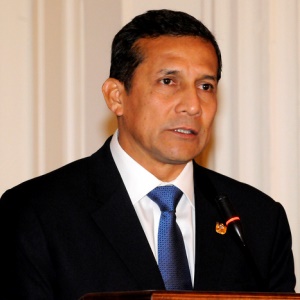
President Humala / Photo credit: OEA - OAS / Foter.com / CC BY-NC-ND

President Humala / Photo credit: OEA – OAS / Foter.com / CC BY-NC-ND

Facing growing public discontent, President Humala is attempting to navigate through yet another cabinet shuffle while struggling to advance reforms of the police, education, and health care.  The President’s approval rating has dropped from 65 percent soon after his inauguration in 2011 to an all-time low of 27 percent.  He swore in his fourth prime minister, César Villanueva, last week, after telling Prime Minister Juan Jiménez – in office for just 15 months – that it was time to “refresh” the cabinet.  Jiménez said he had been contemplating resigning for months, but recent polls suggest that growing crime and corruption, the two main issues citizens perceive to be afflicting the nation, forced him out.

Protests against Humala’s government have been growing.  In July, 8,000 demonstrators in Lima expressed their rejection not only of Humala’s government, but of the entire ruling political class.  Although still small compared with protests in other parts of Latin American, they were of a magnitude not been seen in the capital city since 2000, when protestors took the streets demanding President Fujimori´s resignation.  Unlike the rural indigenous protests over extractive industries, which have become commonplace under the administration, the participation of the middle class was evident and crucial in the July protests.  Social anger was sparked by a video showing members of the main political parties secretly negotiating highly controversial appointments involving individuals implicated in corruption.  Persons who had allegedly violated human rights were selected as the human rights ombudsman and as judges of the Constitutional Tribunal.  The uproar motivated Congress to immediately annul the secretly negotiated appointments, known as the repartija, which for many Peruvians resembled one of the traditional means by which the authoritarian government of Alberto Fujimori had avoided institutional checks and balances by placing regime-friendly officers in power.

The recent Peruvian protests are similar to social mobilizations taking place in Brazil, Chile and Colombia – other countries in which economic growth has not translated into broad public satisfaction.  While many protests in these countries have focused on the quality of social services, the recent Peruvian demonstrations have offered a critique of the country’s widespread corruption and backroom politics.  Peruvian demonstrators came from diverse sectors of society, including labor union members, students, artists, TV actors, gay rights activists, without clear leadership or coordinated demands.  This amorphous type of protest appears particular in Peru because civil society largely avoids political activism as a consequence of the stigmatization of collective social action after the defeat of Shining Path in the ‘90s.

Humala’s most recent cabinet reshuffle and his earnest but ineffective reform efforts suggest he appreciates the depth of the social discontent – now with middleclass support and the participation of youth.  Peruvians are not willing to tolerate the traditional corruption associated with the country’s politicians.  The lack of coordination among social movements that can connect rural and urban discontent, as well as the absence of political parties within the Peruvian landscape that can effectively mediate between citizens and the government, might limit the scope of social protests to isolated outcomes. If protestors come up with a clear agenda through legitimate leadership, however, President Humala will have to deepen his reforms or risk irrelevance through the remainder of his presidency.  Superficial changes appear unlikely to appease the middle class and civil society.

What Can Be Learned from the Humala Government?

By Rob Albro

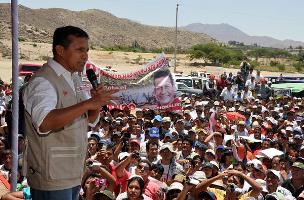
President Humala inaugurating electric power in the rural district of Moro - Ancash Photo credit: Presidencia Perú / Foter.com / CC BY-NC-SA

President Humala inaugurating electric power in the rural district of Moro – Ancash Photo credit: Presidencia Perú / Foter.com / CC BY-NC-SA

As a candidate in Peru’s 2006 presidential election, one-time military coup plotter and current president Ollanta Humala presented himself as an anti-business socialist and nationalist happy to be a member of the “family” of left-leaning Latin American governments led by Venezuela’s Hugo Chávez.  In his second successful bid for office in 2011, Humala sharply changed direction and embraced a combination of pro-business and anti-poverty measures reminiscent of Brazil’s center-left Lula.  Humala’s shifts are a sign of the times in the Andean region:  a non-ideological search for how best to build democracies and grow national economies, while effectively redistributing wealth.

Driven by its mining sector and a commodity export boom, Peru’s economy has tripled in size over the past decade and is currently one of the best performing in the world.  Foreign investment is flooding in, particularly to mining, hydrocarbons, and big infrastructure projects – and Humala is now considered an “investor darling.”  While backing off electoral promises to nationalize water, electricity, mining and other sectors, Humala has created a new Ministry of Development and Social Inclusion and increased the budget for social redistribution and welfare measures to Peru’s poorest by 50 percent.  So far Humala has channeled the budget surplus of Peru’s export boom, including successful negotiation of a $1.1 billion increase in mining royalties in 2011, toward reducing the nation’s poverty rate by 29 percent.  And yet, at present there are more than 250 ongoing social conflicts in Peru, and Humala’s government has been accused of failures of “consultation,” often by grassroots and indigenous protestors opposed to Peru’s mining policies.  In response Humala has reshuffled his cabinet multiple times.  Skeptics suggest that his approval rating – currently 60% – will last only as long as the boom enables his top-down social spending.

Humala’s presidency suggests the limits of viewing current regional leaders through a comparative Chávez-or-Lula lens.  Arguments over the best conditions for “foreign direct investment” in the region often miss the different conditions under which it occurs or purposes to which it might be put.  Humala’s pragmatism demonstrates how distinct parts of government need not reflect a single unifying ideological or normative idée fixe.  Liberal democratic institutions and market freedoms increasingly coexist alongside alternative policies of social redistribution as a part of democratic enfranchisement in the Andes.  When conflict has broken out, however, Humala’s government has been willing to forego consultation with local communities to insure the economic resources it needs to continue its redistributive policies.  The challenge for him to achieve the best balance between competing democratic priorities will continue.  Humala’s government is an opportunity to explore new democratic institutions in Latin America, as with a recent CLALS research project on participatory democracy

Peru: Humala’s Difficult Balancing Act

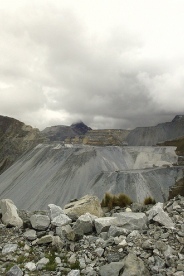
Photo: Peruvian mine | Mihai (clandestino_20) | Flickr | Creative Commons

Peru’s new cabinet installed in July – President Ollanta Humala’s third since his inauguration a year earlier – faces the daunting task of sustaining national development while increasing social enfranchisement.  The reshuffle came amid loud criticism of a crackdown, which killed five people, on protests against the proposed $5 billion Conga mining project in Cajamarca.  The incident underscored the difficulty for Humala as he endeavors to implement a dual strategy of capitalizing on the growth potential of Peru’s mining industry – primarily gold and copper (60 percent of exports) – while respecting community concerns about the environmental consequences of extraction.  Mining wealth is needed to improve the lives of ordinary people –28 percent of Peruvians live in poverty – but unlike preceding governments this administration has committed itself to consultation with residents of localities that will be affected directly.    The new prime minister has announced suspension of the Conga project until the U.S. mining company involved provides better environmental guarantees.

Humala’s popularity has plummeted.  Despite new laws increasing Peru’s mining revenue, the creation of a new Ministry of Social Inclusion, and a new Prior Consultation Law, indigenous protesters feel betrayed by Humala.  They accuse him of continuing the aggressive extractive policies of his predecessor, Alán García, and insist his administration has not given adequate attention to concerns of local communities on issues such as the integrity of the water supply in zones affected by the mining ventures.  Recent signs of a resurgence in violence by the Sendero Luminoso (Shining Path) guerrillas and of setbacks in efforts to curtail the influence of the narcotics trade are also eroding Humala’s support.

Humala narrowly won the presidency as a center-left candidate, committed to creating a framework for the more equitable distribution of the wealth generated by Peru’s natural resources.  Now, some of his political allies say he has courted foreign investment for the mining sector without adequate consultation, and further protests seem likely.  Humala’s challenge is not unlike that of other countries, including Bolivia and Ecuador, trying to balance between these competing interests.  His success or failure will have an impact beyond Peru’s borders, as South American countries dependent on commodity exports struggle to walk the tightrope between satisfying foreign investors and domestic electorates.