
by Andréia Fressatti Cardoso and Ernesto Castañeda*
November 15, 2023
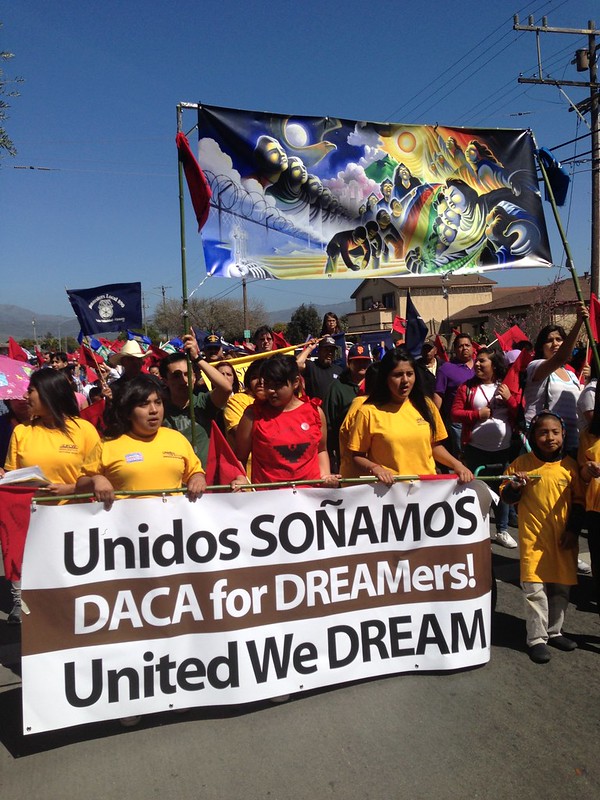
Once again, the future of DACA is in question. On September 13, 2023, Judge Andrew Hanen from the Southern District of Texas declared the Deferred Action for Childhood Arrivals (DACA) program to be illegal in the case, Texas v. United States (2021). He addressed two items in his decision, the 2012 DACA Memorandum and the 2022 Final Rule. Andréia Fressatti Cardoso has been conducting interviews with DACA recipients, organizers, and some attorneys as part of an on-going research, and we dive in on their views on the impacts of this and previous court decisions on the program. All names used here are pseudonyms, protecting the anonymity of the interviews in this research.
Since 2018, the Department of Homeland Security cannot process any new DACA applications. The DACA protection for individuals who applied before then has been kept in a legal and political limbo for quite some time, and as the future of DACA seems more uncertain, the age restrictions and the impossibility of processing new applications has gradually diminished the number of beneficiaries of the policy. It is estimated that around 579,000 people benefit from DACA now – a much smaller number than the 800 thousand people estimated to have benefitted from DACA at its peak, which in turn is less that the people how could have potentially benefited from it but decided not to apply due to fear of future deportation.
The September 13 decision is part of an effort to end DACA. An attempt to end the program in 2017 by the Trump administration was unsuccessful due to the lack of observance of due procedure to do so according to a Supreme Court’s 2020 decision. The strategy of conservative opponents then shifted towards forcing DACA to gradually die out by not allowing new applications to be accepted. This strategy has created a new group of subjects in the struggle for immigrant rights, which are the DACA-eligible, those who could have DACA if the courts had not continuously forced the program to pause for new applicants.
Also, the language used when discussing immigration is of paramount importance, as it draws the borders of belonging and membership. It is noteworthy that the September 13 decision insists on calling people who immigrate “illegal aliens,” even sparing a long footnote to defend such terminology. More than being offensive, the “illegal alien” reifies an us and them, an Other (the alien, the foreigner) whose belonging, and membership is not recognized due to the lack of authorization to cross a border, their undocumentedness. Such dehumanizing language has been part of the vocabulary of people who want to keep the U.S. white when referring to undocumented immigrants in the United States.
DACA was never meant as a permanent solution, but as a temporary fix for people who immigrated to the U.S. when minors. Nonetheless, the lack of legislative action for the many years that the program has been in place turned the DACA into a buoy for many migrants. But, as pointed out in an interview with Maria*, a DACA recipient in her late-twenties, “DACA was a Band-Aid to Obama not being able to pass actual immigration reform.” The on-going legal battle over DACA has reinforced the limbo into which young migrants have been pushed to: a status that is neither of undocumented nor of belonging, an uncertain in-between.
One of the consequences of such a legal battle is on the impacted people’s mental health, as fear and stigma come back as defining factors in their lives, similarly to what happened when the Trump administration tried to rescind DACA, as pointed by Ana*, a DACA recipient at her mid-twenties: “and when Trump came and had an opportunity to strike DACA down, it felt very scary. I felt like I was losing hope, and I was like, I was going to lose a lot, like, everything that I’ve done for myself.” And, for those who could not apply for DACA before, Judge Hanen’s decision is even more disheartening, as pointed out by Rosa*, who meets all the criteria for DACA but cannot apply: “it’s horrible because, like, you have this hope, that there’s going to be something good coming out of it, but then it just gets worse and worse. So, honestly, that makes me not even want to hope for it anymore.”
When talking to people who are beneficiaries of DACA, words such as “tiring,” “stressful,” and “uncertain” are not uncommon, especially from those who are or were activists: The two-year time frame of the program was already a factor to limit long-term planning, but the limbo to which they have been pushed reactivates a “survival mode” in which much of the undocumented population in the United States lives.
The uncertainty that people live under is clear. It is hard to fathom for people who are not in this situation; but other situations might convey similar feelings, such as when one remembers the uncertainty felt in the middle of the pandemic when people wondered when vaccines would become available, when schools would open, and when the pandemic would subside. DACA recipients have been living with this uncertainty for 11 years plus the years before the program existed. Jose*, a 28-year-old DACA recipient, explained the feeling:
“And so, all of these maneuvers are very much like, ‘OK, I have this platform not for long, so what can I get out of it?’ And that to me seems like it’s playing the short game, playing as if there is not going to be longevity for DACA. And there hasn’t. And I think that ever since 2017, right, like, the majority of my existence under DACA has been now under the assumption that DACA is going to end at some point, or that DACA is under danger.”
DACA still survives but it is unclear for how long. The conservative members of the Supreme Court could unilaterally kill DACA, despite the popularity of the program and how favorably Americans of all political perceptions see Dreamers. It is hard to think of an alternative to such a scenario. Both DACA recipients and organizers have been assessing what other alternatives they have, while keeping up with the news and decisions on the program and hoping for the best.
*All names used here are pseudonyms, protecting the anonymity of the interviews in this research.
* Andréia Fresssatti Cardoso, Research Fellow at the Center for Latin American and Latino Studies at American University, and PhD candidate in Political Science at the University of São Paulo, Brazil. Her project, “Rights Subjectivity in Immigrant Struggles for Rights in the United States: The Struggle for DACA,” has a grant from the São Paulo State Research Foundation (FAPESP, process n. 2022/04176-5). The opinions, hypotheses, conclusions, and recommendations expressed in this material are the full responsibility of the author and do not represent FAPESP’s views.
*Ernesto Castañeda, PhD is the Director of the Center for Latin American and Latino Studies, the Immigration Lab, and the MA Program in Sociology, Research, and Practice. He is also a member of the Im/migrant Well-being Scholar Collaborative.


 AULA Blog