
China in Latin America: Is the Dragon Here to Stay?

By Ivanova Reyes & Amy Ruddle

Source: Based on Gallagher et al. (2012).

Source: Based on Gallagher et al. (2012).

As China has become a major importer of Latin American & Caribbean commodities, it has significantly increased its financing and investment in the region.  Data on Chinese investment is not complete, but we estimate that it reached 38 percent of the combined financing from the IDB and World Bank to the region during 2005-11, with Venezuela getting the most.  In 2010 China became the third largest outside investor in the region (behind the United States and the Netherlands), and it provided an estimated $22 billion in 2011 – approximately 13 percent of total investment flows to Latin America and the Caribbean.

This investment is likely to continue to grow.  The Chinese government provides tax breaks, lines of credit and other incentives for companies to invest in key industries overseas, and a great deal of its lending corresponds to “finance for assured supply,” such as a  $10 billion loan from the Chinese Development Bank to Brazil’s Petrobras in 2009 in exchange for 200,000 barrels of oil per day.  Currently, according to Gallagher et al. (2012), 72 percent of the Chinese lending to the region is in the oil and mining industries and in related infrastructure projects.  The remaining funds lent in recent years have gone towards other infrastructural developments (21 percent), and towards trade, finance, and communications (7 percent).  Latin American countries have implemented policies aimed to attract Chinese investment.  They generally impose fewer conditions than those demanded by international financial institutions and require less compliance with environmental standards.

Recent surveys indicate that citizens overall view the growing influence of China in the region as a positive thing.  Indeed, Vanderbilt University’s AmericasBarometer found in 2012 that 20 percent of respondents viewed China as already the most influential country in the region, and an average of 63 percent said it had a positive influence.  However, respondents see China as less trustworthy than the United States.  Across those nations polled, roughly 38 percent viewed China as “very trustworthy” or “somewhat trustworthy,” whereas 45 percent had similarly positive views of the United States.

Although the growing Chinese investment and trade may give Latin America and the Caribbean a great opportunity to generate growth, there are several challenges.  If Chinese participation in the mining and oil industries results in environmental degradation, indigenous rights advocates and community organizations already skeptical of commodity driven growth will increasingly confront Latin American states as well as foreign enterprises. In addition, Chinese concentration in the commodities industries has generated strong structural changes in Latin American economies, further relegating manufacturing to a secondary role and raising the possibility of Dutch disease, in which high commodity prices harm other exports by reducing the country’s competitiveness.  It has become commonplace to observe that South America is building a 21st century economy on a 19th century logic of primary product exports. A third concern is that, since Latin America as a region is the smallest recipient of Chinese investment in the world, China will turn elsewhere if governments start putting conditions on Chinese projects.  Ultimately, these concerns make a strong case for Latin American countries to cultivate stronger ties with the Chinese economy while remembering that China’s strategic interest in extractive industries may collide with each country’s own development strategies.


References

ECLAC. 2010. “Chapter III: Direct investment by China in Latin America and the Caribbean.” In ForeignDirect Investment in Latin America and the Caribbean. Retrieved November 2013, from http://www.eclac.cl/publicaciones/xml/0/43290/Chapter_III._Direct_investment_by_China_in_Latin_America_and_the_Caribbean.pdf.

Faughnan, Brian M. and Elizabeth J. Zechmeister. 2013. “What do Citizens of the Americas Think of China?” AmericasBarometer: Topical Brief, June 13.

Gallagher, Kevin P., Amos Irwin, and Katherine Koleski. 2012. “The New Banks in Town: Chinese Finance in Latin America.” In 30 Years of Inter-American Dialogue Report: Shaping Policy Debate for Action.

Zechmeister, Elizabeth J., Mitchell A. Seligson, Dinorah Azpuru, and Kang Liu. 2013. “China in Latin America: Public Impressions and Policy Implications.” Presentation of the LAPOP.

Dominicans of Haitian Origin: Foreigners in Their Native Land

By Maribel Vásquez

Haitian sugar cane workers in the Dominican Republic / Photo credit: ElMarto / Foter.com / CC BY-NC-ND

Haitian sugar cane workers in the Dominican Republic / Photo credit: ElMarto / Foter.com / CC BY-NC-ND

Nearly three months after the Dominican Republic stripped residents born to unauthorized migrants of their Dominican citizenship, the Constitutional Tribunal’s controversial decision remains the source of high tensions in the country. The ruling expanded on a 2010 amendment to the Constitution stating that children born in the Dominican Republic must have at least one parent with legal residency to be eligible for Dominican citizenship. The court has now determined that the ruling can be applied retroactively to 1929 – in effect leaving three generations of immigrants’ children in legal limbo. At an estimated 200,000, Dominicans of Haitian descent are the largest affected group. In recent years, they have already been denied identity documents, and officials have refused to return copies of their birth certificates, arguing that such births occurred while their parents were “in transit” and therefore did not meet the criteria for Dominican nationality.

International criticism of the ruling was immediate. Many critics have called it racist. After visiting the Dominican Republic earlier this month, the Inter-American Commission on Human Rights (IACHR) released a highly critical report. The United Nations Higher Commission for Refugees (UNHCR) has also expressed concern that the court’s decision threatens to leave hundreds of thousands stateless. CARICOM has called on the Dominican Republic to “right this terrible wrong” and suspended its membership application. Caribbean leaders have expressed outrage.  Trinidad and Tobago’s Prime Minister, Kamla Persad-Bissessar, said the ruling created a “grave humanitarian situation,” and the former prime minister of Antigua and Barbuda, Lester Bird, said the ruling was “so absolutely racist that it’s almost pathetic.” The United States has kept an extremely low profile on the issue.

The tribulations of Haitians in the Dominican Republic date back to the country’s independence in 1844, after 22 years of Haitian occupation, during which tensions between Dominicans and Haitians were high. Since then, relations between the two peoples of Hispañiola have often been in turmoil, most notably when Dominican dictator Rafael Trujillo in 1937 issued orders that led to el corte – “the cutting” – that massacred over 30,000 Haitians along the border. The Constitutional Tribunal’s decision appears to reflect the tradition of anti-haitianismo that underlines Dominican national identity. It raises questions about the legal status of past political figures and surely excludes the living from political processes. Applied retroactively, for example, the ruling leaves former Santo Domingo mayor and three-time presidential candidate, José Francisco Peña Gómez stateless in death. While the prospect of another el corte is inconceivable for many of the now-stateless Dominicans of Haitian descent, incidents of violence against them have risen since the ruling – and activists have called the disenfranchisement of Haitian-Dominicans a “civil genocide.”

Venezuela: Maduro versus Capriles, again

By Michael McCarthy*

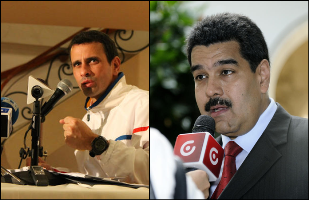
Henrique Caprile / Photo Credit: ICP Colombia / Foter.com / CC BY-SA and  Nicolas Maduro / Photo credit: OEA - OAS / Foter.com / CC BY-NC-ND

Henrique Capriles / Photo Credit: ICP Colombia / Foter.com / CC BY-SA and
Nicolás Maduro / Photo credit: OEA – OAS / Foter.com / CC BY-NC-ND

Venezuela’s municipal elections on December 8 didn’t conclusively answer the single question on people’s minds:  Would the parties aligned under the leadership of President Nicolás Maduro or those under opposition leader Henrique Capriles win a commanding victory?  Attention centered on this question because Capriles had rejected the results of the April 14 balloting as fraudulent and this time called on voters to give a clear majority to his opposition “electoral bloc.”  Maduro came out ahead in last Sunday’s contest, with its complex ballot asking voters to choose mayors and councilpersons in 335 districts.  His alliance, the United Socialist Party of Venezuela (PSUV) plus left-wing parties, totaled 49 percent of the vote, and parties aligned with the opposition received 42 percent.

But Maduro’s crowing about a “great victory” that propels the Bolivarian Revolution forward with “greater force” and legitimates a “deepening of the economic offensive” rings hollow.  Some of the 9 percent of the vote that went to candidates identified as independents may lean toward him, but the PSUV aspires to be a hegemonic party, claiming a much stronger base, and some hardcore chavistas are complaining about the opposition’s resilience in major urban centers and victories in the capitals of three interior states, all chavista strongholds, including former President Chávez’s home state of Barinas.  In broad strokes, Maduro’s economic populism – attacks last month on so-called economic criminals and measures forcing stores to lower prices – gave him a late boost.  Polls indicate that, with annual inflation running at 54 percent, the move paid off.  Maduro’s blitzkrieg gave urban working-class voters a means to afford items ahead of Christmas and showed the radical base of chavismo his commitment to challenge crony capitalism.  The opposition failed to mount an effective counterattack.  Preparations next year for 2015 National Assembly elections will tell the staying power of this victory for Maduro and the effectiveness of his “economic offensive.”   Capriles, who offered a calm post-election speech, sounded confident of his strategic game, but some in the opposition are probably disappointed that they did not take more Chavista strongholds.

Even though the opposition didn’t win the global numbers game, its significant presence in city halls around the country gives it a position from which to build the outline of a governance model.  One important winner appears to be the electoral process itself, in which the technical machinery ran smoothly and no sustained allegations of fraud were made.  A second winner was governability.  Notwithstanding some bullying of Capriles campaign workers, no violence transpired during the campaign or on voting day, and both sides can claim victories.  Maduro’s triumphalist rhetoric confirms that Venezuelan politics is going to remain far from harmonious, but even a modicum of governability could go a long way as the country faces many tough, if not intractable, questions in the coming year and beyond.

*Michael McCarthy is Lecturer, Latin American Politics, at Johns Hopkins University, School for Advanced International Studies.

Haiti: Crisis as Usual

By CLALS Staff

World Bank Group President Jim Yong Kim and Haitian President Michel Martelly / Photo credit: World Bank Photo Collection / Foter / CC-BY-NC-ND

World Bank Group President Jim Yong Kim and Haitian President Michel Martelly / Photo credit: World Bank Photo Collection / Foter / CC-BY-NC-ND

Half way through his term, President Martelly and his opponents have shown the same weak leadership and shallow commitment to democracy and transparency that has long plagued Haitian politics.  The IMF recently reported preliminary data indicating that Haiti’s GDP grew around 4 percent in FY2013; that inflation dropped from almost 8 percent to 4.5 percent; and that, although the fiscal deficit was larger than planned, domestic revenues were in line with projections.  On the streets, however, popular suffering shows no sign of abating.  Some 170,000 remain homeless since the earthquake almost four years ago; hundreds of thousands still have no prospect of employment, and poverty rates remain sky-high.  Suspicions about the whereabouts of more than a billion dollars in foreign aid are growing.  The World Bank last week criticized the lack of government transparency regarding funds from Venezuela’s “Petrocaribe” program, worth about $300 million a year to Haiti, and repeated its call for an end to the government’s use of “non-compete” contracts.  Corruption, a perennial concern, was a main theme of several large protests last month, involving thousands of citizens demanding Martelly’s resignation.

United Nations officials have repeatedly called on Haiti to hold parliamentary elections originally scheduled for two years ago.  The lower house of parliament in November passed a bill protecting the tenure of certain members of the senate – which the UN Secretary General’s senior representative in Haiti praised as “an important step for the organization of inclusive, transparent, and democratic elections” – but myriad other preparations remain undone.  The UN last August found that failure to hold elections by next month “runs the risk of [the Parliament] becoming inoperative,” but the Security Council went ahead and renewed the MINUSTAH mission for yet another year, albeit with fewer troops and police.

Donor fatigue – when the international community tires of lending a hand – seems to have been overtaken by donor disinterest, and the Haitian political elite appears much obliged.  Martelly, whose stage name was Sweet Micky during his singing career, has failed to use his fame and charm to promote serious reform among Haitians, as he promised, nor has he weaned his government and its supporters off the lucre of corruption.  His detractors, like those organized against Presidents Préval and Aristide before him, are better at mobilizing opposition than they are at mustering support for any political alternatives.  The Obama Administration’s commitment after the earthquake to help Haiti “build back better” has faded.  A central element of its vision was construction of an industrial park in northern Haiti, which more than a year after its inauguration has created fewer than 2,000 of the 65,000 jobs it promised.  As long as Haitians and their international supporters are satisfied with bandaid solutions to systemic problems, the country will wallow in its misery until the next crisis makes things yet worse again.

Subnational Regimes Reveal Uneven Nature of Democracy

By Agustina Giraudy

Peruvian mayoral campaign poster / Photo credit: Pedro Rivas Ugaz / Flickr / CC-BY

Peruvian mayoral campaign poster / Photo credit: Pedro Rivas Ugaz / Flickr / CC-BY

Most Latin American countries have transitioned away from autocracy and authoritarianism over the past three decades, but much of their democratic advancement has been territorially uneven and mostly limited to the national level.  In Argentina, Peru, Brazil, Bolivia, Mexico and other countries, democracy has not trickled down to subnational levels of government.  Many provinces, states, and municipalities in these (and other) countries continue to be governed in ways that resemble the period of undemocratic rule.  In these subnational undemocratic regimes (SURs), the political and civic rights of regular citizens and the political opposition are severely curtailed.

In SURs such as Formosa, San Luis or La Rioja in Argentina; Oaxaca (pre 2010), Puebla (pre 2010), or Tabasco in Mexico; and Goiás in Brazil, provincial autocrats use a variety of undemocratic, illegal, and informal actions – such as electoral fraud, electoral violence, and changes in electoral rules and political institutions – to prevent the opposition from gaining access to state positions.  My research and others’ indicates that, to further protect their own power, these subnational rulers frequently and arbitrarily reshuffle provincial- and state-level supreme courts, capriciously remove opposition mayors from office, deny funding to municipalities controlled by the opposition, and arbitrarily commission provincial- and state-level audits to investigate contrived financial misdeeds of opposition mayors.  They also co-opt or divide local organized groups, such as small unions, social movements, and street vendors, to undermine potential opposition.

The existence of SURs within national democracies underscores the difficulty of assessing the quality of a democracy from a purely national perspective.  As recent research has shown, the continuation of SURs in national democracies requires that we take a different approach and, importantly, grasp how seemingly democratic national-level leaders benefit from and, in some circumstances, encourage the SURs as a reliable base outside the capital.  Subnational undemocratic rulers, who typically control voters and legislators in the national congress, are seen by national officials as key partners for crafting winning electoral and legislative coalitions.  To the extent that national democratic incumbents succeed at inducing and securing autocrats’ cooperation, the former have strong incentives to help the latter stay in power.  Ironically, the accepted practice of democratic coalition-building contributes to the obstruction of democratization at the subnational level.  In the second decade of the 21st century, the quality of Latin American democracies depends at least as much on subnational democracy – and reducing the influence of SURs – as on the quality of national-level institutions.

Mexican Judicial Reform: Example of the Need for a Closer Look

By Todd A. Eisenstadt

Foro: el Nuevo Sistema de Justicia Penal, a un Año de su Implementación en Baja California, con la ponencia: “Hacia una Justicia más Transparente” /Photo credit: Gobierno de Baja California  / Flickr / CC

Foro: el Nuevo Sistema de Justicia Penal en Baja California / Photo credit: Gobierno de Baja California / Flickr / CC

Mexico’s judicial reforms have proceeded at an uneven pace in each of the country’s 32 states since they were approved as a constitutional amendment in 2008.  The new and spacious “tower of justice” in Baja California shimmers in the desert sun, an outward sign of the $100 million-plus program that is the centerpiece of the state’s “law and order” administration.  However, halfway across Mexico, in the state of Puebla, litigators, police, and judges – untrained in the new judicial system they are implementing – watch their first important case, a manslaughter conviction, give way to a plea bargain after a series of errors.  Morelos, Oaxaca and other states do not have inter-connected computer systems for prosecutors and defenders, and Nayarit has not even passed a state-level criminal justice code to bring that state up to compliance with the 2008 reforms.  And Chihuahua, where Ciudad Juárez in 2011 held the distinction of being the most violent city in the world, a punitive “counter-reform” reducing the rights of the accused has set back that state’s reform efforts.

Progress on the reforms has been stymied by lack of a litigation tradition, a failure in interagency cooperation, a shortage of technology and resources, a lack of political will, and a lack of public support.  Mexico’s drug-related violence has put it at the center of hemispheric debate on judicial reform, but even heralded reforms of the 1990s, such as in Argentina, Bolivia, Panama, and Peru, have been unevenly implemented.  Chile’s reforms, widely seen as successful, were made possible by overcoming inertias, including judicial resistance to the creation of an adversarial relationship between defense and prosecution that moved judges into an institutionalized neutral position.  Legal scholar Mauricio Duce also argues that the retooling of Chile’s Ministerio Público – an autonomous body that functions as a fiscalía or justice ministry – was crucial because the institution became the “engine” of the reforms.

Each country brings its own history, culture and institutional strengths and weaknesses to the challenge of judicial reform. With the results of the first generation of reforms so mixed, a rigorous review of  what has worked – and not – in Latin America, Africa, or Eurasia and elsewhere can help overcome these dramatic shortcomings in the implementation of  reforms. The political commitment to reform is important, but understanding the political contexts and legal/administrative components in each case is also essential for improving the rule of law and accountability, deterring violent crimes, improving human rights recognition, economic development, and establishing security and law and order. When academics, program managers, and political leaders understand why a country like Mexico can have such vastly varying results from the same reforms, they can all take a giant step toward achieving more lasting and positive change.

Todd A. Eisenstadt is a professor of government at American University.